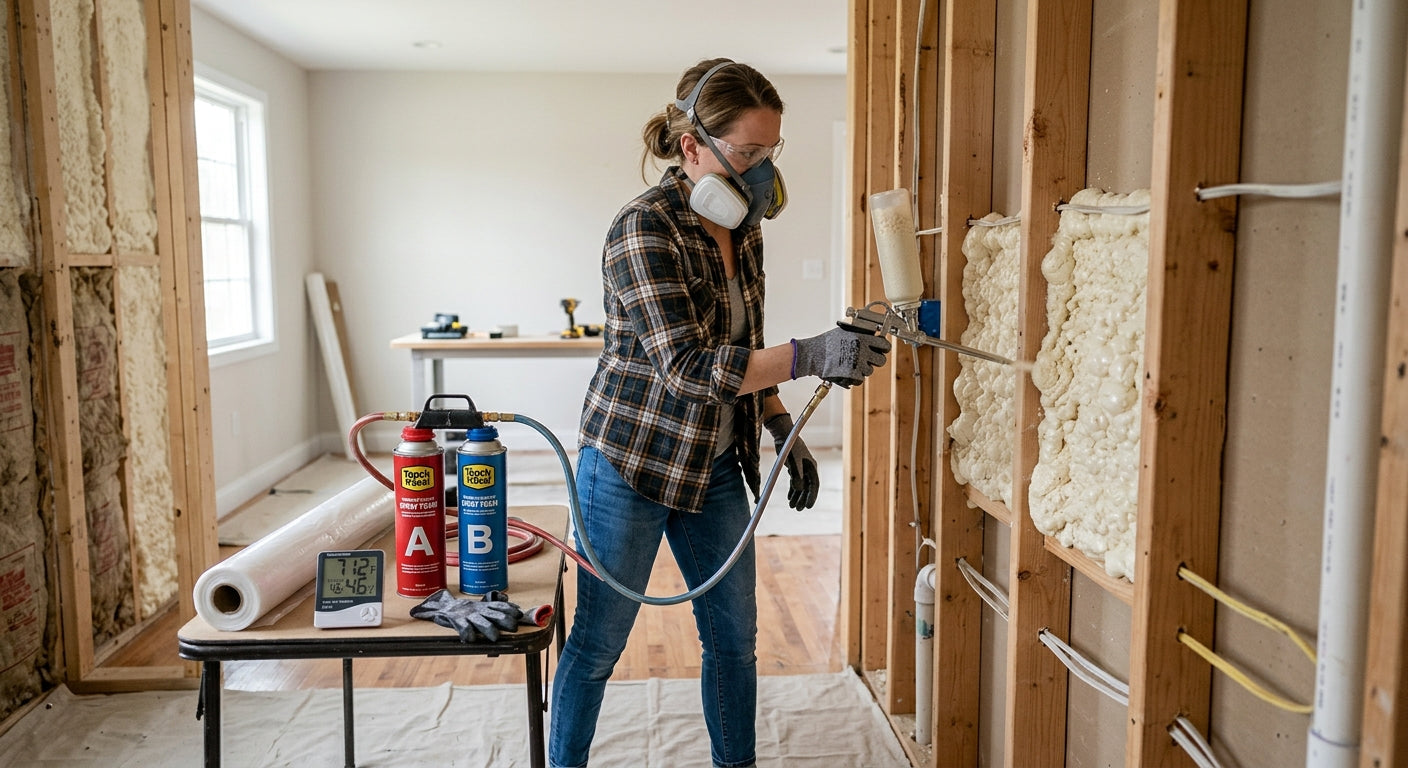
Spray foam insulation can look simple to apply, but temperature can change the entire result. If the foam, surface, or work area is too cold or too hot, you may get weak adhesion, poor expansion, uneven coverage, or wasted material.
That becomes especially frustrating with DIY spray foam kits. You can prepare the area correctly and follow the spraying steps, yet still lose yield because the chemical tanks or the surface being sprayed are outside the recommended temperature range.
The best approach is to check three temperatures before starting: the foam chemicals, the surface, and the surrounding air. For many spray foam systems, moderate conditions work best, but the exact limits always depend on the product's technical instructions.
What Is the Best Temperature for Spray Foam Insulation?
For many spray foam products, about 70°F to 85°F is a useful target for the foam chemicals themselves. Some low-pressure two-component systems list an optimum chemical temperature of 75°F to 85°F, while allowing wider application and surface temperature ranges.
VB Insulation's existing guidance also identifies 70°F to 80°F as a favorable general range for spray foam application and curing conditions.
| Temperature Check | Practical Target | Why It Matters |
|---|---|---|
| Foam chemicals | Around 70°F–85°F* | Supports proper flow, mixing, expansion, and yield |
| Surface temperature | Within product-rated range | Helps foam bond correctly |
| Air temperature | Within product-rated range | Supports consistent application and curing |
| Surface vs. dew point | Keep surface safely above it | Helps prevent hidden condensation |
*Always use the temperature range printed in your specific product manual or technical data sheet.
If you are new to the process, understanding DIY spray foam basics before opening the kit can prevent common preparation and application mistakes.
Three Temperatures Matter More Than One
Checking the room thermometer alone is not enough. A garage may feel warm while the foam tanks remain cold from overnight storage. A wall may also be much colder than the surrounding air.
1. Chemical Temperature
Chemical temperature means the actual temperature inside the spray foam tank or cylinder. Cold chemicals become harder to move through the system and may not mix or expand as intended.
Some low-pressure foam systems recommend core chemical temperatures around 75°F to 85°F.
When preparing a DIY insulation project, condition the kit according to its instructions before spraying instead of assuming a warm room has already warmed the chemicals.
2. Surface or Substrate Temperature
The substrate is simply the surface receiving the foam. It may be wood, metal, concrete, drywall, or roof sheathing.
Surface temperature matters because spray foam must bond to that material. Some low-pressure systems allow substrate temperatures from about 40°F to 100°F, but other products have different limits.
This is why an infrared thermometer can be more useful than checking room temperature alone.
3. Ambient Air Temperature
Ambient temperature is the temperature of the surrounding work area.
It affects chemical behavior, surface temperature, and curing conditions. However, it should not be used as the only measurement. A metal wall, concrete floor, or roof deck can be noticeably hotter or colder than the surrounding air.
Why Dew Point Matters When Applying Spray Foam
Temperature is closely connected to moisture. A surface can look dry but still develop condensation when its temperature approaches the dew point.
Some professional spray foam technical data sheets require the substrate to remain at least 5°F above the dew point and free from dew, frost, or other moisture.
Moisture can interfere with foam adhesion and finished foam quality. This matters especially on metal buildings, concrete surfaces, crawl spaces, and roof decks.
What Happens If Spray Foam Is Too Cold or Too Hot?
Spray foam reacts quickly after application. Temperature outside the product's recommended limits can change how that reaction happens.
| Condition | What You May Notice | Possible Result |
|---|---|---|
| Chemicals too cold | Slow or uneven flow | Lower yield or poor mixing |
| Surface too cold | Foam pulls away or bonds poorly | Gaps and weak adhesion |
| Surface is damp | Irregular foam or poor bonding | Reduced insulation quality |
| Chemicals too warm | Foam reacts too quickly | Harder spray control |
| Surface too hot | Very fast reaction | Uneven texture or reduced working time |
Cold material can reduce kit yield because viscosity rises and dispensing becomes more difficult. Industry guidance commonly recommends keeping many spray foam materials around 70°F to 80°F before use, unless their data sheet states otherwise.
Temperature can therefore affect the real amount of insulation you get from a kit. Before purchasing material, calculate your required spray foam coverage and leave room for normal jobsite variables.
Can You Apply Spray Foam in Cold Weather?
Yes, some spray foam can be installed in cold weather, but the product must be approved for those conditions.
Certain cold-weather closed-cell formulations can work at lower substrate temperatures than standard products. Other kits may require the surface and surrounding space to be warmed before application.
Do not assume that warming the room for a few minutes solves the problem. Thick concrete, exterior sheathing, and metal can remain cold after the air temperature rises.
For larger jobs, fast-rise spray foam also requires close attention to the manufacturer's temperature, pass-thickness, and application instructions.
How Temperature Changes by Surface

Different building materials react differently to outdoor weather. Measuring the surface directly gives you a better picture of actual spraying conditions.
| Surface | Main Temperature Concern | What to Check |
|---|---|---|
| Wood framing | Cold or damp surface | Temperature and moisture |
| Metal | Rapid heating and cooling | Surface temperature and condensation |
| Concrete | Holds cold for long periods | Temperature and dryness |
| Roof decking | Sun can raise surface heat | Check several areas |
| Attic framing | Large temperature swings | Air and surface temperatures |
Attics deserve extra attention because roof decks can change temperature quickly during the day. Proper preparation is important when planning an attic spray foam application.
Does Open-Cell and Closed-Cell Foam Use the Same Temperature?
Not always.
Open-cell and closed-cell spray foam use different formulations, and temperature limits can also change between brands. Professional technical sheets show wide differences in allowable substrate, ambient, drum, and processing temperatures.
The safest rule is simple: follow the temperature instructions for the exact foam you are using rather than relying on a universal temperature range.
For projects requiring dense insulation and strong air sealing, closed-cell spray foam kits provide several options for different project sizes.
Does Temperature Affect Spray Foam Thickness?
Temperature can affect expansion and yield, but it should not be used to decide how thick each pass should be.
Spray foam creates heat while curing. Applying more foam in one pass than the manufacturer allows can trap excessive reaction heat and damage the finished foam. The Spray Polyurethane Foam Alliance recommends following manufacturer limits for pass thickness and time between passes.
Before building several layers, check the recommended closed-cell foam thickness for the project and product being used.
How to Check Conditions Before You Spray

A quick jobsite check can prevent wasted foam and help produce more consistent coverage.
-
Check the kit's required chemical temperature.
-
Measure the actual surface with an infrared thermometer.
-
Confirm the surface is clean and dry.
-
Watch for frost, dew, or condensation.
-
Make a small test spray when conditions are uncertain.
-
Follow the stated pass thickness and waiting time.
For homeowners handling smaller projects, properly selected DIY spray foam kits can simplify setup, but temperature and surface preparation still need to be checked before spraying.
Never Overheat Spray Foam Tanks
Do not use an open flame or uncontrolled heat source to warm pressurized spray foam cylinders.
Manufacturers set storage and operating temperature limits for a reason. For example, HandiFoam states that certain cylinders should not be stored above 90°F, while its optimum chemical storage range is 75°F to 85°F.
Condition the material using only methods allowed in the product instructions.
The Bottom Line
For many spray foam systems, 70°F to 85°F is a strong general target for chemical temperature, but there is no single application temperature that fits every foam.
The better approach is to check the chemical temperature, substrate temperature, ambient air, moisture, and dew point before spraying. Your product's technical instructions should always take priority over a general temperature recommendation.
Correct conditions also help you get closer to expected coverage, maintain good adhesion, and avoid wasting material on a project that needs to be removed or sprayed again.
Frequently Asked Questions
What temperature is too cold for spray foam insulation?
It depends on the product. Some kits allow application near 40°F, while specialized professional systems may have different limits. Always check both the minimum air and substrate temperatures listed by the manufacturer.
Is 50°F too cold to spray foam?
Not necessarily. Some spray foam products are rated for use at 50°F or below. However, the foam chemicals may still need to be much warmer. Check the tank temperature and surface temperature separately.
What temperature should spray foam tanks be?
Many portable two-component foam systems perform well when their chemicals are around 70°F to 85°F. The exact target depends on the kit, so follow its operating instructions.
Can I warm spray foam before using it?
Yes, when the manufacturer allows it, but use only approved conditioning methods. Never use an open flame or expose a pressurized cylinder to temperatures above its stated storage limit.
Should the wall or the room temperature be checked?
Check both, but the wall or substrate deserves special attention. Surface temperature directly affects adhesion, and it may be much colder or hotter than the surrounding room air.