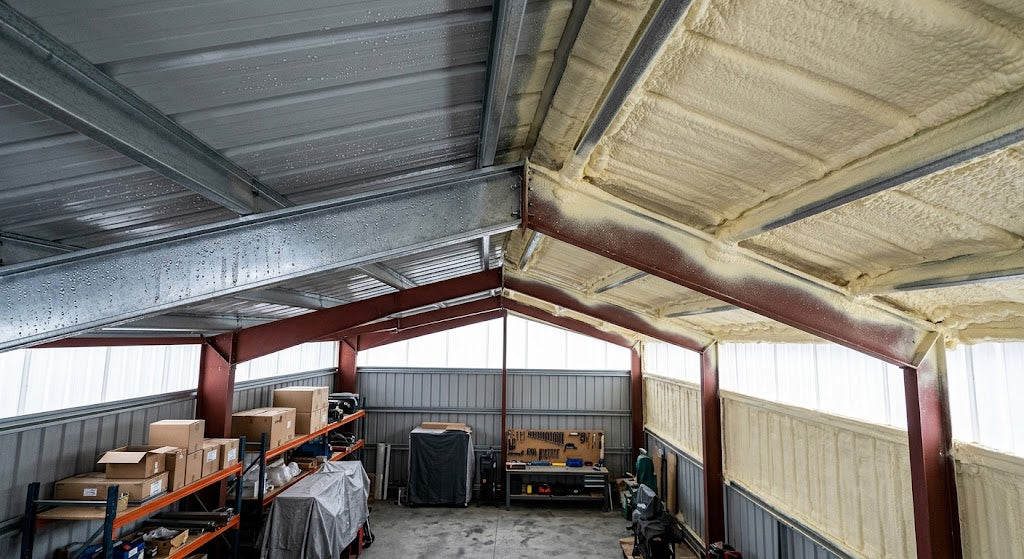
Condensation in a metal building can look like a roof leak. Water beads on roof panels, drips onto tools or stored materials, and may leave damp spots near purlins. For shop, barn, garage, and warehouse owners, the problem can become costly if it keeps returning.
The frustrating part is that wiping up water does not solve the cause. Metal changes temperature quickly. When warm, moisture-filled indoor air reaches cold steel, water can form again. Repeated wetting can also raise the risk of corrosion, damaged contents, and musty conditions.
Closed-cell spray foam addresses the problem at the building surface. It creates insulation and an air-sealing layer directly against metal, limiting contact between humid indoor air and cold steel. When properly designed and installed, this helps keep interior-facing surfaces warmer and reduces condensation risk.
Why Do Metal Buildings Get Condensation?
Metal panels have very little insulating value by themselves. Their interior surface temperature can move close to outdoor conditions. If that metal becomes colder than the dew point of nearby air, water vapor changes into liquid water on the panel.
If you want a simple background on the material itself, this guide to spray foam insulation basics explains how expanding foam seals gaps while adding thermal resistance.
Dew Point in Simple Terms
Dew point is the temperature at which air can no longer hold all its moisture as vapor. Condensation happens when a surface falls below that temperature. The higher the indoor humidity, the easier it is for a cold roof or wall panel to reach that condition.
|
Condition |
What Happens |
Condensation Risk |
|
Warm, dry air meets cool metal |
Less moisture is available to condense |
Lower |
|
Warm, humid air meets cold metal |
Surface may fall below dew point |
High |
|
Air leaks reach hidden cold steel |
Moisture can condense behind insulation |
High |
|
Steel is covered by continuous insulation |
Indoor air has less contact with cold metal |
Lower |
How Does Closed-Cell Spray Foam Stop Condensation?

Closed-cell spray foam works because it controls several parts of the moisture problem at once. It insulates the panel, limits air movement, and slows water-vapor movement. The Metal Construction Association recommends closed-cell foam for metal-panel applications because of its water-resistant properties.
1. It Separates Humid Air From Cold Steel
Spray foam adheres directly to properly prepared metal and fills small gaps around panel shapes, seams, and framing details. That continuous layer makes it harder for warm indoor air to reach the cold steel surface where condensation would otherwise form.
For metal buildings where moisture control is a priority, closed-cell foam options are generally more suitable than open-cell products because they resist water and water-vapor movement more effectively.
2. It Adds a Thermal Break
The foam slows heat transfer between the building interior and the metal shell. With enough insulation, the surface facing the indoor space stays warmer during cold weather. A warmer interior-facing surface is less likely to fall below the indoor air’s dew point.
This is also why improving spray foam efficiency is not only about energy bills. Better thermal control can also support more stable surface temperatures.
3. It Limits Air Leakage
Air movement can carry moisture into cold building cavities. A continuous air barrier helps stop humid indoor air from bypassing insulation and reaching cold metal at panel laps, corners, penetrations, or roof-to-wall connections.
4. It Can Provide Vapor Control
Closed-cell foam has much lower vapor permeance than open-cell foam. MCA guidance notes that closed-cell SPF is typically below 1 perm at about 2 inches, though actual performance depends on the tested product and installed thickness.
That makes water-resistant spray foam useful where humid indoor air and cold metal surfaces create regular moisture problems.
Closed-Cell vs. Open-Cell Foam for Metal Buildings
Open-cell foam can insulate and air-seal, but it allows much more water-vapor movement. MCA states that an additional vapor retarder may be needed with open-cell foam where condensation control matters. Closed-cell foam is more commonly used directly on metal panels.
|
Insulation Type |
Air Sealing |
Vapor Control |
Metal-Building Condensation Use |
|
Closed-cell spray foam |
Strong |
Strong at suitable thickness |
Often a good fit |
|
Open-cell spray foam |
Strong |
Limited |
May need added vapor control |
|
Fiberglass alone |
Limited |
Limited |
Can allow humid air to reach steel |
|
Fiberglass with sealed facing |
Depends on installation |
Can be effective |
Works when the full system is sealed |
Choosing the best spray foam type should depend on climate, indoor humidity, roof design, code needs, and how the building will be heated or cooled.
How Thick Should Spray Foam Be to Prevent Condensation?
There is no single thickness that works for every metal building. The correct depth depends on climate, indoor humidity, target R-value, foam vapor permeance, and metal temperature. Condensation control and full energy-code insulation are not always the same target.
MCA notes that closed-cell SPF is commonly around R-6 to R-7 per inch and typically below 1 perm at 2 inches. That does not mean two inches is automatically enough for every roof or wall. Product data and local requirements still matter.
For project planning, the guide to closed-cell foam thickness can help frame the R-value and coverage discussion before material is ordered.
What Can Still Cause Condensation After Spray Foam?
Spray foam works best when it forms a continuous layer. Thin spots, missed seams, exposed purlins, fasteners, or other thermal bridges can remain colder than surrounding surfaces. These local cold spots may still collect moisture when indoor humidity is high.
High indoor moisture also matters. Wet concrete, stored equipment, washing, livestock, and other moisture sources can raise relative humidity. Foam controls the building envelope, but ventilation, dehumidification, or HVAC moisture control may still be needed for the way the space is used.
|
Problem Area |
Why It Matters |
Practical Response |
|
Missed panel seam |
Humid air can reach cold metal |
Seal the gap |
|
Exposed steel framing |
Creates a thermal bridge |
Improve continuous coverage |
|
High indoor humidity |
Raises the dew point |
Control the moisture source |
|
Roof leak |
Adds bulk water behind foam |
Repair the roof first |
|
Standing-seam roof |
Panels need thermal movement |
Check manufacturer guidance |
Condensation or Roof Leak: Know the Difference
Condensation often appears across broad cold surfaces or during sharp temperature changes. A roof leak is usually tied to rain, damaged flashing, penetrations, fasteners, or panel defects. Foam should not be used to hide an active roof leak or wet, corroded substrate.
MCA recommends applying SPF only to metal that is dry and free of dirt, lubricants, and other contamination. It also warns that leaks can become harder to see after foam is installed, so periodic roof and panel inspections remain important.
Special Note for Standing-Seam Metal Roofs
Standing-seam roofs are designed to expand and contract as temperatures change. MCA discourages applying SPF directly in contact with some standing-seam systems because the foam may restrict that movement. The metal-panel manufacturer should be consulted before spraying this roof type.
This detail is easy to miss when choosing a closed-cell spray foam kit, but roof-system compatibility should be checked before application begins.
Before Spraying a Metal Building

A good condensation-control job starts with the surface and the moisture source, not the foam gun. Use this short check before material is applied:
-
Confirm the water is condensation, not an active roof leak.
-
Make sure metal surfaces are clean, dry, and stable.
-
Check for rust, loose fasteners, damaged seams, and failed flashing.
-
Choose foam thickness from climate, humidity, R-value, and product data.
-
Confirm fire protection, ventilation, HVAC, and local code requirements.
For larger jobs, estimating surface area and thickness first makes it easier to calculate foam coverage and avoid running short during a continuous application.
Does Spray Foam Replace Ventilation?
Not always. Spray foam reduces uncontrolled air leakage, but a tighter building still needs planned moisture management. Heated workshops, agricultural buildings, wash areas, and occupied spaces may need mechanical ventilation or dehumidification to keep indoor humidity at a suitable level.
A professional spray foam kit can provide material for larger applications, but equipment choice does not replace proper design, surface preparation, safety controls, or installation technique.
Bottom Line
Closed-cell spray foam reduces metal-building condensation by separating humid air from cold steel, slowing heat flow, sealing air leaks, and resisting vapor movement. Reliable results also depend on continuous coverage, suitable thickness, dry metal, controlled indoor humidity, and a roof system compatible with foam.
FAQs
Can spray foam completely stop a metal building from sweating?
It can greatly reduce or stop surface condensation when closed-cell foam is continuous, thick enough for the conditions, and indoor humidity is controlled. Gaps, thermal bridges, high moisture levels, or active water leaks can still cause wet areas.
Is closed-cell or open-cell foam better for condensation?
Closed-cell foam is usually the better choice for direct metal applications because it has stronger water and vapor resistance. Open-cell foam air-seals well, but it is more vapor permeable and may require a separate vapor-control layer.
Can I spray foam directly onto metal roofing?
Closed-cell SPF can be used on many metal-panel systems, but the metal must be clean and dry. Through-fastened and standing-seam roofs are not the same. Check the panel manufacturer before spraying a standing-seam roof.
Will spray foam stop rust in a metal building?
Spray foam can reduce condensation that contributes to corrosion, but it does not repair existing rust or active leaks. Corrosion should be inspected and treated before foam is applied, and the building should still be checked for hidden water entry.
Do I still need a vapor barrier with closed-cell spray foam?
Often, sufficiently thick closed-cell SPF can provide the needed vapor control, but requirements depend on the product, thickness, climate, and assembly. MCA notes that closed-cell SPF is typically below 1 perm at about 2 inches.