Choosing between a spray foam gun and straw foam can seem harder than it should be. Both systems dispense expanding polyurethane foam. However, they differ in control, cost, cleanup, reuse, and suitable project size.
Straw foam is often the better choice for one small repair. A foam dispensing gun is usually better for repeated work or precise applications. An integrated trigger dispenser sits between these two options.
The right choice also depends on the foam formulation. A better applicator cannot make general-purpose gap filler suitable for every window, fire blocking detail, or insulation project. You must choose the correct foam and the correct dispensing method.
Key Takeaways
The best applicator depends on how often you use expanding foam. It also depends on the bead size, project location, and cleanup you are willing to handle. These points provide a fast overview.
-
Buy basic straw foam for a small, one-time gap-sealing project.
-
Buy a spray foam gun for repeated work, several cans, or precise bead control.
-
Choose an integrated dispenser when you want better control without maintaining a separate gun.
-
Check can compatibility before buying a gun or replacement foam.
-
Select the foam formulation first for windows, doors, fireblocking, pest control, or insulation.
-
Include cleaner in the budget when calculating the total cost of a foam gun.
-
Follow the product label for storage, reuse, ventilation, curing, and protective equipment.
Foam Gun or Straw Foam?
Choose straw foam when the job is small and unlikely to be repeated. Choose a foam gun when you expect to use several cans or need accurate flow control. Choose an integrated trigger dispenser when you need a convenient middle option.
| Feature | Spray foam gun | Basic straw foam | Integrated dispenser |
|---|---|---|---|
| Upfront cost | Highest | Lowest | Low to moderate |
| Bead control | Excellent | Limited | Good |
| Flow adjustment | Adjustable dial or screw | Usually trigger pressure only | Trigger-controlled |
| Stop-start performance | Excellent when maintained | Often messy | Better than a basic straw |
| Reusability | High with correct storage | Usually limited | Product-dependent |
| Cleanup | Requires maintenance | Minimal tool cleanup | Light cleanup |
| Reach | Long, rigid barrel | Short, flexible straw | Varies by design |
| Can compatibility | Requires gun-grade cans | Uses designated straw cans | Built into the can |
| Learning curve | Moderate | Low | Low |
| Best for | Repeated or precise work | One-time repairs | Occasional DIY projects |
| Main drawback | Cost and maintenance | Less control | Less adjustable than a gun |
A gun is not automatically the best purchase for every homeowner. Its benefits become more valuable as the number and complexity of projects increase. A basic straw still makes sense when one inexpensive can can complete the entire repair.
What Are You Actually Comparing?
This comparison covers canned one-component polyurethane foam, often called one-part expanding foam or OCF. It is commonly used around pipes, wires, vents, frames, joints, and utility penetrations. It is not the same system used for spraying entire walls, attics, or roof assemblies.
Larger DIY insulation projects may require two-component foam, hoses, replaceable nozzles, protective equipment, and a wider spray pattern. Those products mix two chemical components as the foam is applied. Canned gap foam normally releases a narrow stream or bead and cures through contact with moisture.
A fast-rise foam kit is designed for broader insulation coverage rather than isolated cracks. Its applicator gun, hoses, and chemical system are different from a reusable gun attached to a single aerosol can. Mixing these categories can lead to the wrong product choice.
What Is Straw-Applied Expanding Foam?

Straw foam is a pressurized can supplied with a narrow plastic tube. The straw attaches to the dispensing valve and directs the foam into a crack or opening. The system is inexpensive, compact, and easy to understand.
The user normally controls output by changing pressure on the can’s trigger or valve. This method works well for simple gaps where perfect bead size is not important. It can become harder to control when the can is nearly empty or the project requires frequent starting and stopping.
Basic Straw Dispensers
A basic straw is the simplest expanding foam applicator. It has few moving parts and does not require a separate tool. After the project, the straw may be discarded according to the product instructions.
Traditional straw systems may clog soon after use. DuPont states that some of its traditional straw products can seal shut when left unused for more than two hours. That limit is product-specific, so users should not apply it to every brand or formulation.
Integrated Trigger Dispensers
An integrated dispenser adds a handle, spring-loaded trigger, or flow-control feature to the can. It provides better stop-start control than a simple plastic tube. It also avoids the cost of buying a separate metal gun.
Some integrated systems are designed for reuse. DuPont markets its Smart Dispenser as reusable for up to 30 days when stored according to its instructions. This is a manufacturer-specific feature rather than a universal rule for all straw-style products.
An integrated dispenser is a strong choice when you:
-
Complete occasional home repairs
-
Want less dripping and mess
-
Need more control than a basic straw
-
Do not want to clean a separate foam gun
-
Prefer a lower initial investment
-
Expect to reuse the can within its rated storage period
What Is a Spray Foam Gun?
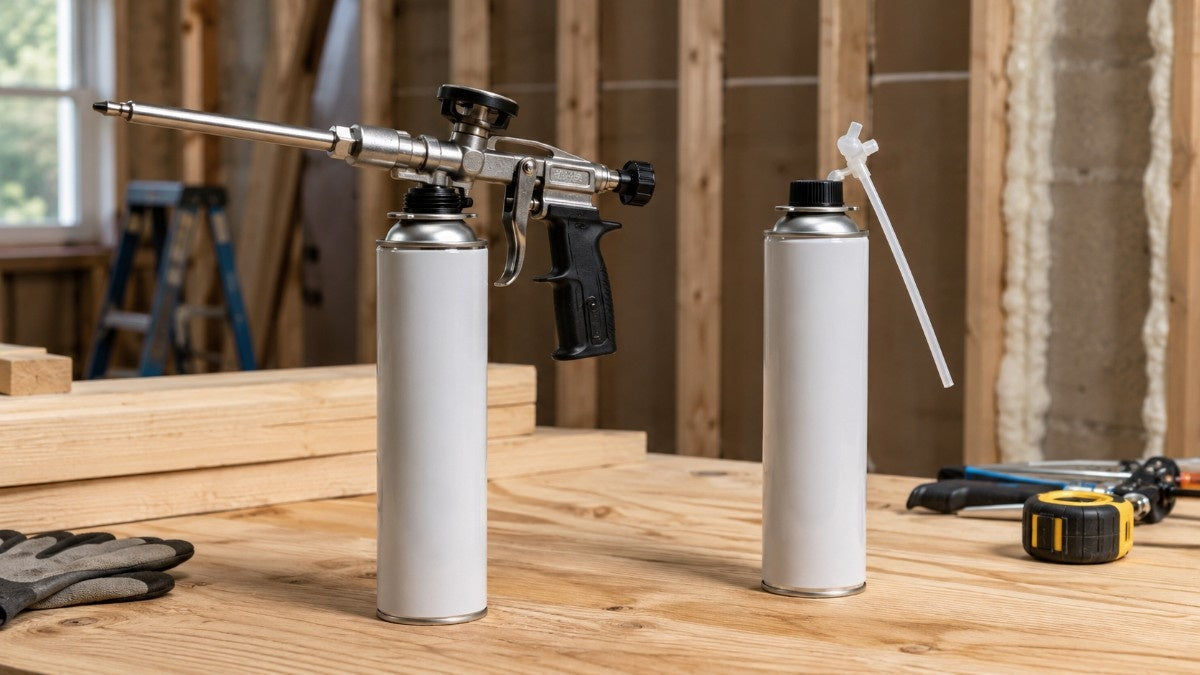
A spray foam gun is a reusable applicator that attaches to a compatible gun-grade can. It usually includes a handle, trigger, threaded adapter, metal barrel, nozzle, internal valve, and adjustment screw. These parts allow the user to meter the foam more accurately.
The flow-control screw limits how far the trigger can open the internal valve. This allows the user to create a narrow bead for small joints or a larger bead for wider gaps. The long barrel can also reach behind pipes, inside recessed openings, and around awkward penetrations.
Sika describes its foam applicator guns as tools for precise application of gun-grade expanding foam. The manufacturer also lists difficult-to-access recessed areas among suitable uses. Its instructions state that these guns should be used with compatible gun-grade products and cleaned while uncured foam is still wet.
A foam gun is only reusable when it is maintained correctly. Cured polyurethane inside the valve or barrel can block the flow path. A badly clogged gun may require disassembly or replacement.
Spray Foam Gun vs Straw Foam: Detailed Comparison
The spray foam gun normally wins on precision and repeatability. Straw foam normally wins on simplicity and initial cost. The real value depends on how often the applicator will be used.
Application Control
A foam gun provides the best control over bead diameter and flow rate. The adjustment screw can be set before the trigger is pulled. This helps the user avoid releasing a large burst into a narrow gap.
A basic straw relies more heavily on hand pressure and user technique. The foam may continue moving through the tube after the valve is released. An integrated dispenser can reduce this problem, but it usually remains less adjustable than a dedicated gun.
DuPont states that its professional dispensing gun can release beads from approximately 1/8 inch to 3 inches. That range is specific to the manufacturer’s equipment and compatible products. It still demonstrates why adjustable guns are useful across different joint sizes.
Bead Consistency
A foam gun makes it easier to maintain a consistent bead across several gaps. This matters around repeated plumbing penetrations, sill plates, service openings, and framing joints. Consistent output can also make the finished work easier to trim.
A straw can produce acceptable results with practice. However, bead size may change as trigger pressure, can temperature, or can orientation changes. The difference becomes more noticeable during long applications.
Access and Reach
A gun’s metal barrel provides direct access to deep or recessed joints. The rigid tube is easier to aim than a flexible straw in some situations. Long-barrel guns and nozzle extensions can reach even farther.
A flexible straw has its own advantage. It can bend around an obstruction where a straight barrel cannot fit. The better option depends on the shape and location of the opening.
Speed
A foam gun is usually faster when sealing many similar gaps. The user can set the desired output and move between openings with fewer adjustments. This makes the system useful for maintenance, remodeling, and installation work.
Straw foam is fast to set up for one small task. There is no separate applicator to inspect, attach, adjust, or clean. Its convenience becomes less valuable when dozens of gaps must be filled.
Which Applicator Wastes Less Foam?
A foam gun can reduce waste by controlling how much material enters each gap. Better metering reduces overfilling and the amount that must be trimmed after curing. It can also help preserve a partially used can when the manufacturer permits attached storage.
A straw system may waste material inside the tube or around the valve. It may also become unusable when the applicator clogs. However, a neglected foam gun can waste an entire can and add the cost of replacing the tool.
No universal waste-saving percentage applies to every project. Foam yield changes with formulation, can temperature, joint size, humidity, application technique, and expansion behavior. Manufacturer ratings should be treated as estimates rather than guaranteed field results.
For broad insulation work, accurate foam coverage calculations are more important than the choice between a straw and a canned foam gun. Large surfaces are normally measured in square feet and board feet. Small gap-sealing projects are more often estimated by joint length and bead size.
Which System Is Best for Your Project?
The best applicator depends on the number of gaps and the accuracy required. It also depends on whether the product will be used again soon. The table below matches common projects with the most practical option.
| Project | Recommended applicator | Why it fits |
|---|---|---|
| One pipe penetration | Basic straw | Low cost and fast setup |
| Several plumbing penetrations | Foam gun | Repeated, controlled beads |
| Small draft around trim | Integrated dispenser | Good stop-start control |
| Window or door installation | Gun or controlled dispenser | Precise low-pressure application |
| Basement crack sealing | Gun for many cracks; straw for one crack | Choice depends on volume |
| Attic air-sealing work | Foam gun | Many joints and penetrations |
| Electrical service openings | Foam gun | Better placement and flow control |
| Occasional pest-entry sealing | Integrated dispenser | Convenient for periodic repairs |
| Daily contractor use | Professional foam gun | Durable and adjustable |
| Large wall or roof area | Two-component insulation system | Canned gap foam is not the correct format |
The table recommends an applicator rather than a specific foam formula. The product must still be approved for the substrate, joint, and intended use. Fireblocking, windows, pest exclusion, and general air sealing may require different products.
Before purchasing, consider the best foam selection for the actual assembly. Density, expansion, flexibility, moisture performance, and thermal resistance vary. The applicator only controls how the product is delivered.
Is a Spray Foam Gun Worth the Money?

A foam gun is worth buying when its additional control and reuse offset the tool’s cost. This usually happens when the user completes several projects or uses multiple cans. There is no universal number of cans that guarantees a financial benefit.
The full cost includes more than the price of the gun. Cleaner, replacement tips, compatible cans, storage, and maintenance should be considered. Time saved during repeated applications may also have value.
| Cost factor | Foam gun system | Straw foam system | Buying impact |
|---|---|---|---|
| Applicator | Reusable gun purchase | Included with can | Straw costs less initially |
| Foam cans | Gun-grade cans required | Standard cans required | Prices vary by product |
| Cleaner | Usually needed | Usually not needed for the applicator | Adds to gun ownership cost |
| Replacement parts | Tips, extensions, seals, or gun | New straw comes with each can | Depends on maintenance |
| Leftover foam | May be reusable when stored correctly | May clog after opening | Gun may offer better lifecycle value |
| Overapplication | Easier to control | More technique-dependent | Gun may reduce excess |
| Setup time | Longer for one job | Very short | Straw suits quick repairs |
| Cleanup time | Higher | Lower | Straw suits users avoiding maintenance |
| Work speed | Faster across many gaps | Slower on repetitive work | Gun suits larger workloads |
| Tool life | Can last through many projects | Disposable applicator | Gun benefits frequent users |
Use this simple comparison before buying:
Foam gun ownership cost
-
Foam gun
-
Compatible gun-grade cans
-
Gun cleaner
-
Extensions or replacement tips
-
Maintenance time
-
Possible replacement cost
Straw foam ownership cost
-
Individual straw cans
-
Unused material lost after clogging
-
Additional cans needed because of overapplication
-
Cleanup of drips or excess cured foam
-
Extra working time on repeated gaps
A one-time homeowner may save money with a straw can. A remodeler or maintenance worker may recover the cost of a gun through speed and control. An occasional DIY user may find an integrated dispenser more economical than either extreme.
Can You Reuse an Opened Foam Can?
An opened foam can may be reusable, but the answer depends on the dispensing system and manufacturer instructions. Storage time is not determined only by whether the applicator looks like a straw or gun. The valve design, formulation, seal, and storage method also matter.
Reusing Basic Straw Foam
Basic straw foam often has the shortest practical reuse period. Foam can cure inside the narrow tube or around the valve. Cleaning only the visible tip may not remove material farther inside the straw.
Do not remove the applicator unless the instructions allow it. Do not improvise with sharp tools around a pressurized can. Store and dispose of the product according to the label.
Reusing an Integrated Dispenser
Some integrated dispensers can be stored with the applicator attached. The user may need to clean the tip, release pressure slowly, close a control screw, and store the can upright. Every step should follow the instructions for that specific product.
A stated reuse period is not a guarantee that every partially used can will work perfectly. Damage, poor storage, cured residue, and expired material can affect dispensing. Inspect the valve and applicator before reuse.
Reusing Gun-Grade Foam
Some gun-grade cans can remain attached to a closed gun between projects. DuPont states that certain products may remain attached for a defined storage period, but that period varies by product. One product page specifies up to 90 days, while other professional products may carry different instructions.
Do not assume that removing a partly used can is always the safest storage method. Disconnecting the can can expose the gun adapter to uncured material and air. Follow the gun manual and the foam label together.
Can Regular Straw Foam Be Used in a Spray Foam Gun?
Regular straw foam generally cannot be attached directly to a standard foam gun. Gun-grade cans normally use a threaded or specially designed valve connection. Basic straw cans are made for their supplied dispensing hardware.
Do not force a can onto an incompatible adapter. A poor connection can leak uncured foam or damage the valve. Compatibility should be confirmed through the can label, product data sheet, or gun instructions.
Even products from the same manufacturer may use different systems. A gun advertised as universal may still be limited to a particular valve standard. Check both the applicator and can before purchasing.
Choose the Foam Formulation Before the Applicator
The applicator determines how accurately foam is delivered. The formulation determines where the foam can be used and how it performs. Choosing the wrong product with a good gun still produces the wrong system.
When planning a larger project, DIY foam preparation should begin before opening any can or kit. The work area, substrate, ventilation, temperature, and protective equipment must be prepared. Application should begin only after the instructions have been reviewed.
General Gaps and Cracks Foam
General-purpose expanding foam is commonly used around utility penetrations and construction joints. It can help reduce air leakage when applied to suitable gaps. It should not be treated as a universal substitute for caulk, fire-rated sealant, flashing, or structural repair materials.
Check the rated gap size before application. Very large cavities may require backing material, several controlled passes, or a different product. Overfilling a deep opening can create a large mass of foam that cures unevenly.
Window and Door Foam
Window and door foam should use a low-pressure or minimal-expansion formulation. Excessive pressure can distort a frame or interfere with operation. A precise gun helps, but it does not replace the correct product formula.
Apply small beads and allow room for expansion. Follow the window manufacturer’s installation details and the foam manufacturer’s instructions. Test the window or door after the foam has cured and before finishing the trim.
Fireblock Foam
Fireblock foam is not the same as ordinary general-purpose foam. Use only products whose labeling, testing, and approvals match the required application. Local building codes may also determine where the product is acceptable.
The terms “fireblock,” “fire-resistant,” and “fireproof” are not interchangeable. A brightly colored foam is not automatically approved for every fire-rated assembly. Confirm the product classification before installation.
Pest-Blocking Foam
Pest-blocking foam can help close selected entry gaps. However, foam alone may not stop every rodent or insect. Some pests can chew through exposed foam or find another opening.
Effective exclusion may require mesh, flashing, hardware cloth, sealant, or another durable barrier. Avoid filling active animal nests or trapping wildlife inside a structure. Identify the pest and entry path before sealing.
Open-Cell and Closed-Cell Foam
Open-cell and closed-cell are descriptions of foam structure, but these terms cover many product systems. Open-cell foam systems are generally softer and more flexible than dense closed-cell products. Product specifications should guide the final decision.
Larger closed-cell spray kits may be used for wall, attic, basement, crawl-space, or metal-building insulation when approved for the assembly. They should not be confused with a small can of gap filler. Two products can both be described as polyurethane foam while having different equipment, coverage, safety requirements, and intended uses.
How Expansion Affects Your Choice
Foam expansion depends mainly on the formulation rather than the applicator. A gun can reduce the amount initially dispensed, but it does not convert high-expansion foam into low-expansion foam. The label should state the product’s intended use and expansion characteristics.
High-expansion foam may fill a cavity quickly. It can also create more trimming work or pressure against nearby components. Low-pressure foam is generally more appropriate around sensitive frames.
For area insulation, closed-cell foam thickness affects thermal performance and material requirements. That type of thickness planning is different from filling a narrow joint with canned foam. Do not estimate wall insulation needs from the size of a gap-filler can.
How to Use Straw Foam Correctly

Straw foam is simple, but preparation still matters. Protect nearby surfaces because uncured polyurethane foam can be difficult to remove. Review the can instructions before attaching or activating the dispenser.
Basic application steps:
-
Confirm that the product suits the gap and substrate.
-
Protect floors, finishes, tools, and nearby objects.
-
Wear the protective equipment required by the label.
-
Prepare the surface as directed.
-
Shake or condition the can according to its instructions.
-
Attach the straw or integrated dispenser securely.
-
Test the flow on a disposable surface.
-
Apply a controlled bead without filling the entire cavity.
-
Allow the foam to expand and cure.
-
Trim excess only after the stated cure stage.
-
Store or dispose of the can according to the label.
Work slowly until you understand the flow rate. A small trigger movement may release more material than expected. Stop before the gap appears completely full because the foam may continue expanding.
How to Use a Foam Gun Correctly

A foam gun requires more setup but provides better repeatability. Inspect the adapter, barrel, trigger, and nozzle before attaching a can. Do not use a damaged or heavily contaminated gun.
Basic gun application steps:
-
Confirm that the gun and can are compatible.
-
Close or limit the flow-control screw.
-
Shake or condition the can as directed.
-
Attach the can without cross-threading or overtightening it.
-
Point the gun toward a safe test surface.
-
Open the adjustment control gradually.
-
Pull the trigger gently to establish the bead.
-
Adjust the flow before approaching the work area.
-
Apply foam in controlled passes.
-
Close the adjustment control after application.
-
Clean or store the gun according to both product manuals.
Keep the gun pointed away from people while attaching or testing a can. Never look into the barrel or place a hand over the nozzle. Treat the attached assembly as a pressurized chemical product.
Foam Gun Maintenance and Cleanup
Foam gun maintenance prevents cured material from blocking the internal passage. Wipe fresh residue from the nozzle and adapter using a compatible method. Do not wait for visible foam to harden before addressing it.
A selection of foam application accessories may include cleaner, extension tubes, gun tips, protective clothing, and replacement nozzles. Each accessory must match the specific foam system. A cleaner that works on uncured foam may not dissolve fully cured polyurethane.
Sika instructs users to clean certain guns with compatible cleaner while the foam is still wet. It also warns that gun-grade applicators should be depressurized before disassembly, cleaning, or reassembly. These details show why maintenance instructions must be reviewed before use.
Common maintenance mistakes include:
-
Leaving uncured foam on the nozzle
-
Removing a can without checking storage instructions
-
Allowing the gun to sit open and exposed to air
-
Using an incompatible solvent
-
Overtightening the can
-
Cross-threading the valve connection
-
Storing the assembly where the can can be punctured
-
Disassembling a pressurized gun
-
Scraping seals with sharp metal tools
-
Ignoring small leaks around the adapter
Safety Considerations
Uncured polyurethane foam can expose users through skin contact, eye contact, vapors, and aerosols. The work area should be ventilated as directed by the manufacturer. People and pets who are not involved in the work should be kept away.
The EPA states that exposure to isocyanates may cause skin, eye, and lung irritation. Exposure may also contribute to asthma and sensitization. Both skin and inhalation exposure should be minimized.
There is no single cure or re-entry time for every product. EPA materials note that some manufacturers estimate approximately 8 to 24 hours for one-component foam, but curing rates vary. The product label and safety data sheet should control the actual decision.
Before applying foam:
-
Read the complete product label.
-
Review the safety data sheet.
-
Confirm ventilation requirements.
-
Remove flames, sparks, and ignition sources.
-
Protect nearby people, pets, and belongings.
-
Wear the specified gloves and eye protection.
-
Use respiratory protection when the instructions require it.
-
Plan how unused product and waste will be handled.
-
Confirm the required curing and re-entry period.
-
Keep emergency contact information available.
Avoid burning, grinding, welding, or performing other hot work near polyurethane foam. Disturbing foam during renovation can create additional dust or emissions. Evaluate existing foam before cutting or heating nearby materials.
Common Buying Mistakes
The most common mistake is choosing an applicator before identifying the project. A gun is useful, but it cannot solve a compatibility or formulation problem. Start with the location, gap size, substrate, and performance requirement.
Another mistake is comparing only the initial price. A low-cost straw can may become expensive if several partly used cans clog. A foam gun may also become expensive if it is rarely used or poorly maintained.
Avoid these buying errors:
-
Buying a gun without checking the valve connection
-
Assuming every can fits every gun
-
Using general-purpose foam around sensitive frames
-
Buying high-expansion foam for a narrow finished joint
-
Ignoring the price of cleaner
-
Assuming a straw can cannot be reused
-
Assuming a gun can remain attached indefinitely
-
Treating fireblock foam as universally fire-rated
-
Using canned gap foam for full wall insulation
-
Estimating performance from can size alone
-
Ignoring temperature and storage requirements
-
Choosing price over product suitability
Frequently Asked Questions
Is a spray foam gun worth buying?
Yes, a spray foam gun is worth buying for repeated or precision work. It provides better control over flow, bead size, and stop-start application. It is less attractive for one small repair because the gun and cleaner increase the initial cost.
Is gun-grade foam better than straw foam?
Gun-grade foam is not automatically chemically better than straw foam. Its main advantage is compatibility with a reusable, adjustable dispensing gun. The correct formulation matters more than the applicator when choosing foam for windows, fireblocking, pest exclusion, or insulation.
Can regular straw foam be used in a spray foam gun?
No, regular straw foam usually cannot be attached to a standard foam gun. Gun-grade cans generally require a threaded or specialized valve connection. Never force a can onto an applicator that is not listed as compatible.
Are all expanding foam guns universal?
No, not every expanding foam gun is universal. Many guns fit a common threaded valve format, but compatibility can still vary by brand, valve, and regional product design. Confirm the specifications for both the gun and the foam can before buying.
Can you reuse a can of expanding foam after opening it?
Yes, some expanding foam cans can be reused after opening. The practical reuse period depends on the valve, applicator, storage method, and manufacturer’s instructions. Basic straws often clog sooner than integrated dispensers or properly maintained gun-grade systems.
How long can a foam can stay attached to a gun?
A foam can can remain attached only for the period allowed by its manufacturer. Some products permit storage for several weeks or longer, while others have different limits. Close the gun, store the assembly correctly, and follow the instructions printed for that exact foam.
Do you have to clean a foam gun after every use?
Not every gun must be fully flushed after every short use. Some systems are designed to remain sealed with a usable can attached. The exposed nozzle should still be maintained, and the full gun should be cleaned whenever the manufacturer directs.
Does gun foam expand less than straw foam?
No, gun foam does not necessarily expand less than straw foam. Expansion is mainly determined by the foam formulation. A gun can help the user release a smaller amount, which may make the final application appear more controlled.
Does a spray foam gun reduce waste?
Yes, a spray foam gun can reduce waste through more accurate dispensing. It can limit overfilling, dripping, and inconsistent bead size. It only saves material when the gun is stored, cleaned, and operated correctly.
Is a foam gun better for windows and doors?
A foam gun is often better for precise window and door applications. However, the user must still select a low-pressure or minimal-expansion window and door formula. A general-purpose high-expansion product can create problems even when applied with a good gun.
What happens when a foam gun clogs?
A clogged foam gun may dispense slowly, leak, or stop working completely. Fresh residue may be removable with a compatible cleaner if the instructions permit it. Fully cured foam inside the barrel or valve may make replacement more practical.
Can canned expanding foam insulate an entire wall?
No, ordinary canned gap filler is generally not intended to insulate an entire wall. It is designed for localized gaps, cracks, joints, and penetrations. Full wall applications normally require an insulation system designed and rated for area coverage.
What is the difference between gun-grade and handheld foam?
Gun-grade foam connects to a separate reusable dispensing gun. Handheld foam includes a straw or integrated applicator with the can. The two formats can contain similar types of polyurethane foam, but their valves and dispensing systems are different.
Is an integrated dispenser as good as a foam gun?
An integrated dispenser can be as practical as a gun for occasional small projects. It usually offers better control than a basic straw without requiring a separate tool. A dedicated gun remains better for highly precise, repeated, or professional applications.
What protective equipment is needed for expanding foam?
The required protective equipment is listed on the product label and safety data sheet. Gloves and eye protection are common minimum precautions, while some applications may require protective clothing or respiratory protection. Ventilation and exposure controls are as important as wearable equipment.
Final Verdict: Spray Foam Gun vs Straw Foam
Buy straw foam when you have one small repair and want the lowest upfront cost. It is quick to set up and requires little applicator maintenance. A modern integrated dispenser provides a useful upgrade when better stop-start control is needed.
Buy a spray foam gun when you expect several projects, multiple cans, or repeated precision work. Its adjustable flow, long barrel, and consistent bead can improve both speed and application quality. The added value depends on correct compatibility, storage, and maintenance.
For most occasional homeowners, straw foam or an integrated dispenser is sufficient. For serious DIY users, installers, remodelers, and maintenance workers, a quality foam gun is usually the better long-term purchase. In every case, choose the correct foam formulation before choosing the applicator.