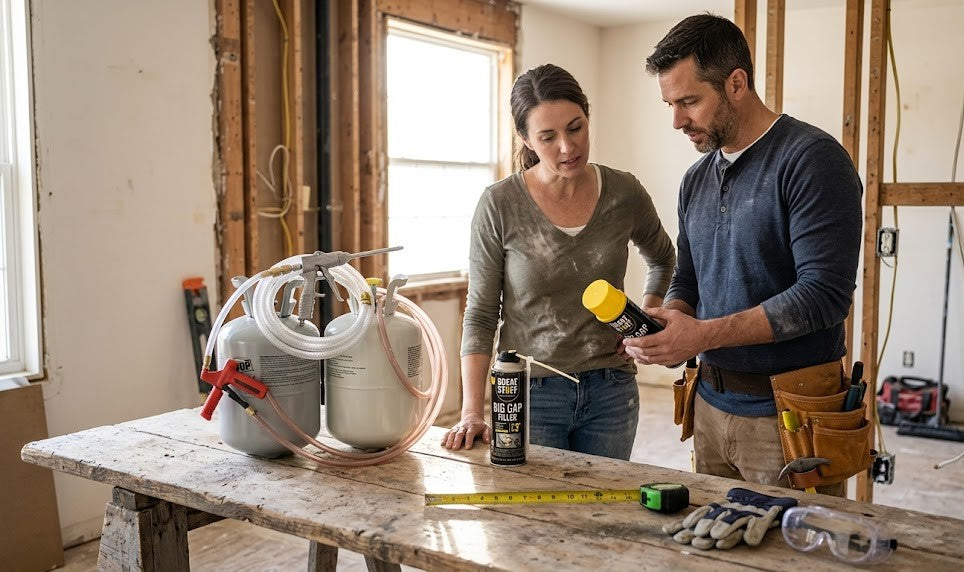
Homeowners often need to insulate, seal, or repair parts of the home to improve comfort and efficiency. Spray foam insulation and gap filler foam can both expand and seal openings, but they are not interchangeable. One is designed to insulate larger areas and improve thermal performance, while the other works best for sealing smaller cracks and penetrations.
Choosing the wrong product can lead to wasted material, higher costs, and poor results. This guide explains the key differences between spray foam insulation and gap filler foam, when to use each one, and how they can work together in real home improvement projects.
What Is Spray Foam Insulation?
Spray foam insulation is a material used to create a thermal and air barrier in larger areas such as walls, attics, basements, crawl spaces, and rim joists. It is made by combining two liquid components that react chemically, expand quickly, and harden into an insulating layer. That reaction allows the foam to fill cavities, reduce airflow, and slow heat transfer.
In many homes, proper insulation matters because the U.S. Department of Energy estimates that air leaks can account for 25% to 40% of the energy used for heating and cooling. That is why many homeowners choose spray foam basics when upgrading insulation in high-loss areas.
Types of Spray Foam Insulation
Spray foam insulation is usually available in two main forms:
Open-Cell Spray Foam
Open-cell foam is lighter, softer, and designed to expand significantly. It works well for interior applications where air sealing and sound reduction matter. Many homeowners compare open-cell options for wall cavities and attic assemblies where flexibility and coverage are priorities.
Closed-Cell Spray Foam
Closed-cell foam is denser and more rigid. It offers a higher R-value per inch and can also add structural strength. For projects that require moisture resistance and stronger insulation performance, many installers use closed-cell kits in basements, crawl spaces, and exterior-facing assemblies.
What Is Gap Filler Foam?
Gap filler foam is a sealing product used for smaller cracks, joints, and openings. It usually comes in a single-component aerosol can and cures when it reacts with moisture in the air. Unlike spray foam insulation systems designed for broad coverage, gap filler is intended for detail work.
It is commonly used to:
- Seal around window and door frames
- Fill small holes where pipes or wires enter the home
- Close cracks in siding or foundations
- Reduce drafts around electrical boxes and utility penetrations
Gap filler foam is best viewed as an air-sealing product, not full insulation for large cavities.
Spray Foam Insulation vs Gap Filler: Key Differences

The biggest differences between spray foam insulation and gap filler foam come down to project size, composition, thermal performance, and intended use. Spray foam insulation is built for insulating larger spaces, while gap filler is designed for spot sealing.
Quick Comparison Table
|
Feature |
Spray Foam Insulation |
Gap Filler Foam |
|
Main use |
Insulates large areas |
Seals small gaps and cracks |
|
Typical project size |
Walls, attics, basements, crawl spaces |
Windows, doors, pipes, wires |
|
Formula type |
Two-part system |
One-part aerosol can |
|
Curing process |
Chemical reaction between two components |
Reacts with air moisture |
|
R-value |
About R-3.6 to R-8 per inch |
Lower, mainly for air sealing |
|
Expansion range |
High coverage for larger cavities |
Controlled filling for small openings |
|
Structural support |
Closed-cell can add rigidity |
Minimal structural benefit |
|
Cost |
Higher upfront investment |
Lower cost for small jobs |
|
Best result |
Whole-area insulation and air sealing |
Targeted leak and crack sealing |
Which Product Performs Better for Energy Efficiency?
Spray foam insulation performs better for energy efficiency in larger assemblies. Its higher R-value and strong air-sealing capability make it more effective in areas where heat loss is significant. In fact, homeowners often review insulation efficiency data when comparing long-term savings from different insulation materials.
Gap filler foam still improves efficiency, but in a different way. It helps stop drafts and uncontrolled air leakage at smaller points throughout the home. While it will not replace full insulation, it can support an overall energy-saving strategy by sealing detail areas that are often overlooked.
When to Use Spray Foam Insulation
Use spray foam insulation for projects where thermal resistance, moisture control, and broad coverage are needed.
Best Uses for Spray Foam Insulation
Spray foam is a strong choice for:
- Insulating open wall cavities in new construction
- Upgrading attic insulation
- Air sealing and insulating crawl spaces
- Reducing heat loss at rim joists
- Improving basement insulation
- Insulating garages, pole barns, and utility structures
Homeowners planning a larger DIY project often compare DIY foam systems before deciding whether the job is suitable for self-installation.
Signs You Should Choose Spray Foam
Choose spray foam insulation when:
- The area is large or open
- Insulation performance matters more than simple crack sealing
- You need a higher R-value
- You want both insulation and air sealing in one application
- Moisture resistance is important, especially with closed-cell foam
How to Apply Spray Foam Insulation

Spray foam insulation works best when applied carefully and under the right conditions. Homeowners considering the job themselves usually benefit from DIY application guidance before starting.
Step-by-Step Application
1. Prepare the area
Make sure the surface is clean, dry, and free from dust, old insulation, and debris.
2. Wear protective gear
Use:
- Gloves
- Safety goggles
- Long sleeves
- A proper respirator
3. Set up the kit correctly
Follow the product instructions closely so the two chemicals mix at the proper ratio.
4. Apply in controlled sections
Spray in manageable passes instead of trying to fill the entire area at once.
5. Let the foam expand and cure
Most products require full curing time before trimming or covering.
6. Trim excess material
Once hardened, trim the cured foam flush with the framing or surface.
Application Tips
- Do not overfill cavities
- Maintain a consistent spray distance
- Watch temperature and humidity conditions
- Check building code requirements for thermal barriers after installation
When to Use Gap Filler Foam

Use gap filler foam when the goal is sealing small openings rather than insulating an entire assembly.
Best Uses for Gap Filler Foam
Gap filler is ideal for:
- Window and door perimeters
- Utility penetrations
- Small cracks in siding or foundations
- Drafty areas around electrical boxes
- Narrow joints where air leakage is noticeable
This product is especially useful for homeowners doing quick air-sealing work room by room.
How to Apply Gap Filler Foam Without Waste

Because gap filler expands after application, a little goes a long way. Controlled application reduces mess and prevents overuse.
Step-by-Step Application
1. Shake the can well
Shake for about 30 seconds so the contents mix properly.
2. Place the straw carefully
Insert the straw slightly into the gap instead of pushing it too deep.
3. Apply in short bursts
Use one-second bursts to control the amount of foam dispensed.
4. Wait for expansion
Allow the foam bead to expand fully before deciding whether more is needed.
5. Add additional layers only if necessary
For deeper gaps, build slowly in layers instead of overfilling at once.
6. Trim after curing
Once cured, trim away any excess foam for a cleaner finish.
Practical Tip
Low-expansion formulas are often the best choice around window and door frames because they reduce the risk of warping.
Can You Use Both Products Together?
Yes, many of the best home sealing projects use both spray foam insulation and gap filler foam together. The two products are complementary, not competitive.
Smart Combination Strategy
Use both products this way:
- Apply spray foam insulation in major insulation zones
- Use gap filler foam for detail sealing around penetrations and framing gaps
- Finish trouble spots after the main insulation layer is complete
Common Project Examples
|
Project |
Best Approach |
|
Exterior wall upgrade |
Spray foam in wall cavities, gap filler around windows |
|
Basement improvement |
Spray foam on rim joists, gap filler around pipes and cables |
|
Attic sealing project |
Spray foam on roofline or floor cavities, gap filler at electrical penetrations |
|
Crawl space upgrade |
Closed-cell spray foam for insulation, gap filler for utility openings |
This approach creates a more complete thermal envelope and better air leak control throughout the home.
Cost Comparison: Spray Foam Insulation vs Gap Filler
Cost is one of the biggest decision factors for homeowners. Spray foam insulation usually has a higher upfront cost because it covers larger areas and delivers stronger insulation performance. Gap filler foam is inexpensive and practical for small jobs, but it does not provide the same full-system benefits.
General Cost Outlook
- Spray foam insulation: Higher initial cost, better long-term energy performance
- Gap filler foam: Low cost, suitable for minor sealing tasks
- Combined use: Often the most practical solution for balanced performance and budget
Homeowners trying to compare products in more detail often review foam performance options to decide which material best fits the project scope.
Conclusion
Spray foam insulation and gap filler foam serve different but closely related purposes. Spray foam insulation is the better choice for large areas that need thermal protection, air sealing, and long-term efficiency. Gap filler foam is the right option for smaller cracks, openings, and finishing work around the home.
For many projects, the best solution is to use both. Spray foam handles the main insulation job, while gap filler seals the smaller problem areas that affect comfort and energy loss. Understanding the difference helps homeowners choose the right material, avoid waste, and get better results from every project.
Frequently Asked Questions
Can I use gap filler foam to insulate an entire wall?
No, gap filler foam should not be used to insulate an entire wall. It is designed for sealing small cracks and openings, not for creating a full thermal barrier.
For whole-wall insulation, use spray foam insulation because it provides:
- Higher R-value
- Better coverage
- Stronger air-sealing performance
What should I do if expanding foam gets where I do not want it?
Clean it immediately if the foam is still wet. Uncured foam can often be removed with a foam cleaner or acetone, while cured foam usually needs to be scraped or cut away.
Steps to handle it:
- Wipe wet foam quickly
- Protect nearby surfaces before starting
- Trim cured foam carefully with a utility knife
- Avoid spreading wet foam by overhandling it
Where should I start if I want a more energy-efficient home?
Start by sealing the biggest air leaks and checking insulation levels. Small leaks around openings can waste energy, and poorly insulated attics and rim joists can increase heating and cooling costs.
A good order is:
- Seal windows, doors, and penetrations
- Check attic insulation
- Evaluate crawl spaces and basements
- Prioritize areas with noticeable drafts or uneven temperatures
How does spray foam insulation compare to gap filler in cost?
Spray foam insulation costs more upfront, while gap filler foam is much cheaper for small repairs. The difference reflects the scale of use and insulation performance.
In general:
- Choose gap filler for minor sealing jobs
- Choose spray foam for larger insulation upgrades
- Consider long-term energy savings when comparing value
Do I need to cover spray foam insulation after installation?
Yes, spray foam insulation usually needs to be covered. In most cases, building codes require a thermal barrier such as drywall over exposed spray foam in occupied spaces.
This matters because the covering helps:
- Improve fire safety
- Protect the foam from damage
- Keep the installation code-compliant
Is it wasteful to use a large spray foam kit for one small crack?
Yes, using a large spray foam kit for one small crack is usually wasteful. Gap filler foam is more cost-effective and easier to control for small openings.
For a small crack, choose gap filler because it offers:
- Simpler application
- Less material waste
- Better control in tight spaces