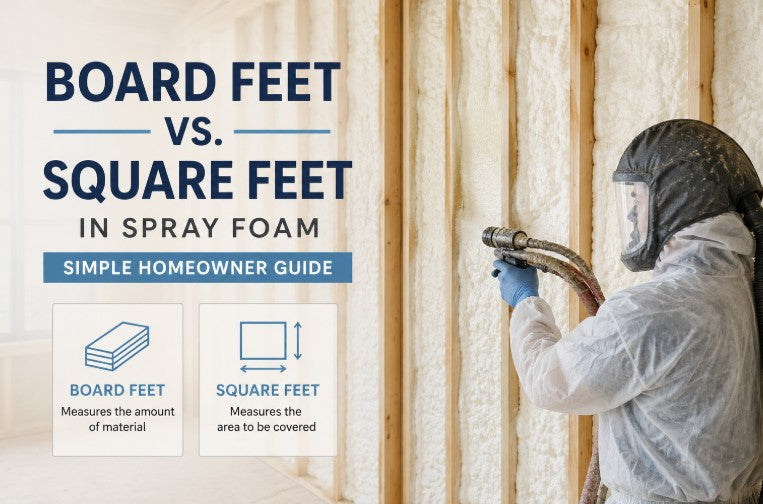
Many homeowners become confused when they receive a spray foam insulation quote. The measurements often show board feet instead of square feet, making it difficult to understand how much insulation is actually being installed.
The difference is simple. Square feet measure area, while board feet measure volume. Since spray foam insulation is applied at different thicknesses, contractors use board feet to calculate the amount of foam required for a project.
Understanding this distinction helps you compare quotes, estimate material needs, choose the right spray foam kit, and avoid unexpected costs.
What Is a Square Foot?
A square foot is a measurement of surface area. It tells you how large a wall, ceiling, attic floor, crawl space, or roof deck is.
For example, a wall that measures 10 feet wide and 8 feet tall contains 80 square feet of area.
Square footage is useful when measuring a space. However, it does not tell you how much spray foam insulation will be needed because it does not account for thickness.
Common Areas Measured in Square Feet
- Exterior walls
- Attic floors
- Roof decks
- Crawl spaces
- Basements
- Rim joists
- Garage walls
Being unfamiliar with spray foam applications, understanding the basics of foam insulation systems can help clarify why thickness plays such an important role.
What Is a Board Foot in Spray Foam?
A board foot is a measurement of volume.
In spray foam insulation, one board foot equals:
1 square foot covered at 1 inch thick
This measurement allows contractors to determine how much foam material is required for a project.
Board Foot Formula
Board Feet = Square Feet × Thickness (inches)
The thicker the foam application, the more board feet are needed.
Simple Example
A 200-square-foot wall sprayed at:
- 1 inch thick = 200 board feet
- 2 inches thick = 400 board feet
- 3 inches thick = 600 board feet
This is why spray foam manufacturers, contractors, and DIY kit suppliers almost always reference board feet.
Board Feet vs Square Feet: The Key Difference
The easiest way to understand the difference is to think of square feet as the size of the surface and board feet as the amount of insulation material needed.
|
Measurement |
What It Measures |
Purpose |
|
Square Foot |
Area |
Size of wall, attic, floor, or ceiling |
|
Board Foot |
Volume |
Amount of spray foam required |
|
Thickness |
Depth |
Converts square feet into board feet |
Without knowing thickness, square footage alone cannot determine insulation requirements.
Why Spray Foam Is Measured in Board Feet
Spray foam insulation is installed at varying depths depending on:
- Desired R-value
- Building code requirements
- Climate zone
- Open-cell or closed-cell foam selection
- Energy efficiency goals
Two attics may each contain 1,000 square feet of area, yet require vastly different amounts of foam.
For example:
|
Attic Size |
Foam Thickness |
Board Feet Needed |
|
1,000 sq. ft. |
2 inches |
2,000 board feet |
|
1,000 sq. ft. |
4 inches |
4,000 board feet |
|
1,000 sq. ft. |
6 inches |
6,000 board feet |
This volume-based approach provides a more accurate pricing and material calculation method.
Homeowners comparing estimates often benefit from understanding coverage calculations before reviewing contractor proposals.
How to Calculate Board Feet for Spray Foam

Calculating board feet is straightforward.
Step 1: Measure the Area
Determine the total square footage of the space.
Example:
40 ft × 10 ft wall = 400 sq. ft.
Step 2: Determine Foam Thickness
Assume the insulation will be applied at 3 inches.
Step 3: Multiply
400 × 3 = 1,200 board feet
The project would require approximately 1,200 board feet of spray foam.
Quick Calculation Table
|
Square Feet |
1 Inch Thick |
2 Inches Thick |
3 Inches Thick |
|
100 |
100 BF |
200 BF |
300 BF |
|
250 |
250 BF |
500 BF |
750 BF |
|
500 |
500 BF |
1,000 BF |
1,500 BF |
|
1,000 |
1,000 BF |
2,000 BF |
3,000 BF |
Open-Cell vs Closed-Cell Spray Foam and Board Feet
The type of spray foam affects thickness requirements and board foot calculations.
Open-Cell Spray Foam
Open-cell foam is lighter and more flexible.
Characteristics include:
- Lower density
- Good sound reduction
- Expands significantly after application
- Typically requires greater thickness to reach target R-values
Many homeowners evaluating attic insulation options compare different attic foam choices before selecting a product.
Commercial and residential projects often utilize professional-grade open-cell foam products when higher expansion rates are desired.
Closed-Cell Spray Foam
Closed-cell foam is denser and more rigid.
Benefits include:
- Higher R-value per inch
- Increased structural strength
- Moisture resistance
- Air sealing performance
Since closed-cell foam provides greater thermal resistance per inch, it often requires less thickness to achieve the same insulation goals.
Projects requiring enhanced thermal performance frequently use closed-cell foam kits for controlled coverage and predictable results.
For many homeowners, understanding proper foam depth is just as important as understanding board feet.
How Board Feet Affect Spray Foam Costs
Most spray foam contractors price projects based on board feet because board feet directly represent material usage.
Several factors influence overall costs:
- Total square footage
- Foam thickness
- Open-cell vs closed-cell foam
- Accessibility
- Existing insulation removal
- Labor costs
- Climate requirements
- Ventilation preparation
- Waste factor
Cost Formula
Estimated Cost = Board Feet × Cost Per Board Foot
A project requiring 4,000 board feet will generally cost more than one requiring 2,000 board feet because significantly more material is used.
Understanding Spray Foam Kit Coverage

DIY spray foam kits often advertise coverage in board feet.This can be confusing for first-time buyers.
For example, a kit rated at 600 board feet does not mean it covers 600 square feet at every thickness.Coverage changes based on application depth.
Example
A 600-board-foot kit can cover:
- 600 sq. ft. at 1 inch
- 300 sq. ft. at 2 inches
- 200 sq. ft. at 3 inches
Many homeowners using portable systems rely on a fast-rise foam kit for smaller insulation projects and repairs.
Additional project supplies and installation tools are commonly found among professional spray foam accessories used to improve application accuracy.
Why Advertised Yield Is Not Always Actual Yield
The stated board foot yield on a spray foam kit is based on ideal laboratory conditions.
Real-world results are often lower.
Factors that reduce actual yield include:
- Cold temperatures
- Surface moisture
- Improper chemical temperature
- Overspray
- Waste
- Installer technique
- Wind exposure
Because of these variables, professionals usually build a margin into their material estimates.
Common Homeowner Mistakes

Many insulation projects become more expensive because homeowners misunderstand board feet.
The most common mistakes include:
Assuming Board Feet and Square Feet Are the Same
They measure different things. Square feet measure area, while board feet measure volume.
Ignoring Thickness
Thickness directly affects material requirements and pricing.
Comparing Quotes Without Checking Foam Depth
One contractor may quote 2 inches while another quotes 4 inches.
The lower price may not provide the same insulation value.
Forgetting About R-Value
The target R-value often determines required thickness.
Believing Advertised Coverage Is Guaranteed
Actual yield can vary significantly depending on site conditions.
Questions to Ask Before Accepting a Spray Foam Quote
Before signing a contract, ask:
- How many square feet are being sprayed?
- What thickness will be installed?
- What is the total board footage?
- Is the foam open-cell or closed-cell?
- What R-value will be achieved?
- Is pricing based on board feet or square feet?
- Are cleanup and disposal included?
- Are ignition barriers required?
- What warranty is included?
- Will ventilation adjustments be necessary?
These questions help ensure that multiple quotes are being compared fairly.
When Should You Contact a Professional?
Professional guidance becomes valuable when:
- Insulating an attic roof deck
- Converting an attic to conditioned space
- Addressing moisture concerns
- Insulating crawl spaces
- Meeting local code requirements
- Evaluating vapor control needs
- Estimating large commercial projects
A qualified insulation contractor can calculate accurate board footage requirements and recommend the appropriate foam type for your climate and building design.
Key Takeaways
- Square feet measure surface area.
- Board feet measure spray foam volume.
- One board foot equals one square foot at one inch thick.
- Board feet are calculated by multiplying square feet by thickness in inches.
- Foam thickness has a major impact on material usage and cost.
- Open-cell and closed-cell foam often require different installation depths.
- DIY spray foam kit coverage is based on board feet, not square feet alone.
- Understanding board feet helps homeowners compare quotes accurately.
Need Help Choosing the Right Spray Foam Solution?
Accurate board foot calculations help reduce waste, control costs, and improve insulation performance. VB Insulation helps homeowners, contractors, and builders choose the right spray foam products for attics, crawl spaces, basements, walls, and commercial spaces.
Get Expert Guidance Before You Buy
Choosing between open-cell and closed-cell foam, estimating board footage, and determining the proper application depth can be challenging without experience. VB Insulation offers access to industry knowledge, quality products, and practical guidance to help simplify the decision-making process and improve project outcomes.
Whether you're planning a DIY insulation upgrade or managing a larger construction project, VB Insulation can help you identify the right spray foam products, coverage requirements, and application accessories needed to complete the job with confidence.
- Professional-grade spray foam products
- Open-cell and closed-cell insulation solutions
- Coverage and board foot guidance
- Knowledgeable assistance for contractors and homeowners
Frequently Asked Questions
1. Why is spray foam sold by board feet?
Spray foam is sold by board feet because thickness affects material usage.The same surface area can require vastly different amounts of foam depending on depth.
2. How do I calculate board feet?
Multiply square feet by foam thickness in inches.
Formula:
Board Feet = Square Feet × Thickness
3. How many board feet are in 100 square feet?
It depends on thickness.
- 1 inch thick = 100 board feet
- 2 inches thick = 200 board feet
- 3 inches thick = 300 board feet
4. Does closed-cell foam require fewer board feet?
Often, yes, but not always. Closed-cell foam has a higher R-value per inch, so it may need less thickness.
- Less thickness can mean fewer board feet.
- Total board feet still depend on area and project needs.
- Code, moisture control, and insulation goals matter.
5. Why does my spray foam quote show board feet instead of square feet?
Because board feet measure foam volume. Square feet only measure surface area.
- Square feet = area size.
- Board feet = area plus thickness.
- Thickness affects material use and cost.
This helps contractors price the job more accurately.
Final Thoughts
Understanding the difference between board feet and square feet eliminates much of the confusion surrounding spray foam insulation estimates. Once you know that square feet measure area and board feet measure volume, spray foam quotes become much easier to interpret.
Whether you are evaluating a contractor proposal, selecting a spray foam kit, or budgeting for an insulation project, board feet provide the most accurate way to estimate material requirements and compare costs.