Choosing the right insulation is not just a construction detail. It directly impacts your home’s comfort, energy efficiency, and long-term costs. Two of the most popular options today are spray foam insulation and rigid foam board insulation.
Both materials perform well in specific situations, but they differ significantly in performance, cost, and durability. This guide breaks down real-world differences so you can choose the smarter investment for your home.
Key Takeaways
- Spray foam offers superior insulation and air sealing
- Rigid foam is more affordable upfront
- Spray foam provides better long-term energy savings
- Installation quality greatly impacts performance
- Moisture resistance is stronger with closed-cell foam
Understanding Spray Foam and Rigid Foam Insulation
What Is Spray Foam Insulation?
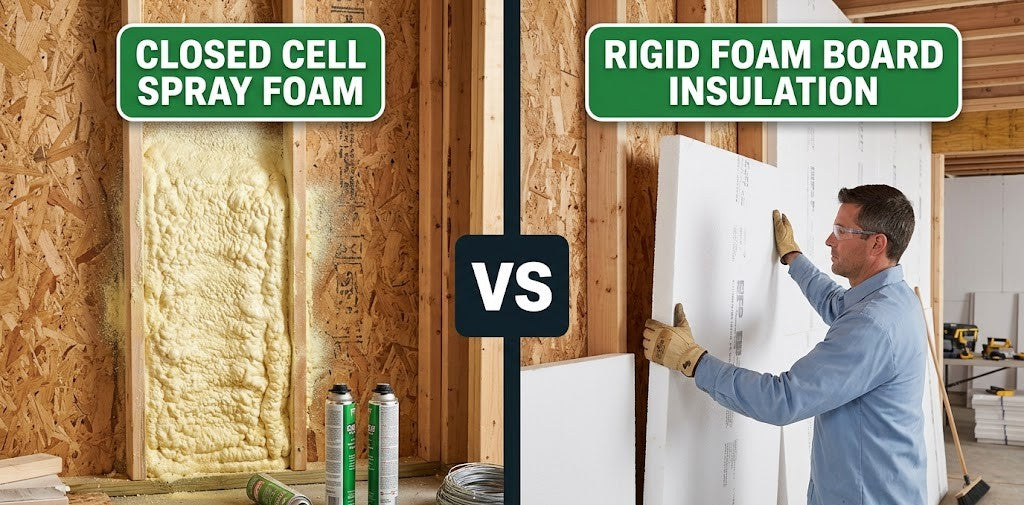
Spray foam is a liquid-applied insulation that expands to fill gaps, cracks, and cavities. It creates a seamless barrier that improves both thermal resistance and air sealing.
There are two main types:
- Closed-cell foam: Dense, high R-value, moisture-resistant
- Open-cell foam: Softer, more affordable, good for soundproofing
For a deeper breakdown of how it works, this overview of spray foam basics explains its structure and benefits.
What Is Rigid Foam Board Insulation?
Rigid foam boards are pre-formed panels made from materials like EPS, XPS, or polyiso. They are cut and installed in flat sections, commonly used in walls, roofs, and basements.
They provide consistent insulation but rely heavily on proper sealing at joints and edges.
R-Value and Energy Efficiency Comparison

R-value measures how well insulation resists heat flow. Higher values mean better performance and lower energy loss.
Insulation Performance Table
|
Insulation Type |
R-Value per Inch |
|
Closed-Cell Spray Foam |
6.0 – 8.0 |
|
Open-Cell Spray Foam |
3.5 – 3.8 |
|
Rigid Foam Board |
3.8 – 5.0 |
Closed-cell spray foam clearly leads in thermal performance. It delivers more insulation in less space, which is critical in tight areas like walls and attics.
Rigid foam boards offer decent insulation but cannot match the density and efficiency of spray foam.
For a closer look at energy performance, this analysis of spray foam efficiency highlights real savings potential.
Cost Comparison: Upfront vs Long-Term Value

Cost is often the deciding factor, but initial price does not always reflect true value.
Installation Cost Table
|
Insulation Type |
Cost per Sq Ft (Installed) |
|
Closed-Cell Spray Foam |
$1.50 – $4.50 |
|
Open-Cell Spray Foam |
$1.00 – $2.50 |
|
Rigid Foam Board |
$0.75 – $2.00 (material only) |
Rigid foam boards are cheaper upfront, especially for DIY projects. However, they often require additional sealing materials and labor.
Spray foam has a higher initial cost, but it reduces heating and cooling expenses by up to 40%. Over time, this leads to significant savings.
Air Sealing and Moisture Resistance
Why Air Sealing Matters
Air leaks are one of the biggest causes of energy loss. Even small gaps can reduce insulation performance significantly.
Spray foam expands to seal every crack and joint. This creates a continuous air barrier that prevents drafts and energy loss.
Moisture Protection Comparison
|
Feature |
Spray Foam |
Rigid Foam Board |
|
Air Sealing |
Seamless barrier |
Depends on joints |
|
Moisture Resistance |
High (closed-cell) |
Moderate |
|
Mold Prevention |
Excellent |
Limited |
Closed-cell spray foam acts as an air barrier, vapor barrier, and insulation in one layer. This makes it ideal for moisture-prone areas.
Rigid foam boards resist water but rely on taped seams. These seams are often the weakest point and can fail over time.
Installation: DIY vs Professional Results

Spray Foam Installation
Spray foam delivers the best results when applied evenly and correctly. Modern DIY kits now allow homeowners to achieve professional-grade sealing without hiring contractors.
If you're considering self-installation, this guide on DIY foam application explains the process step by step.
Rigid Foam Installation
Rigid boards appear simple but require precise cutting and sealing. Each seam must be taped or sealed properly to avoid air leakage.
Even small mistakes can reduce overall performance.
Where Each Insulation Works Best
Spray Foam Is Ideal For:
- Attics with complex framing
- Crawl spaces and rim joists
- Older homes with drafts
- High-humidity areas
Rigid Foam Board Works Best For:
- Flat basement walls
- Exterior continuous insulation
- Budget-focused projects
- Simple DIY applications
Key Differences at a Glance
Final Comparison Table
|
Feature |
Spray Foam Insulation |
Rigid Foam Board |
|
R-Value |
High (up to 8.0) |
Moderate |
|
Air Sealing |
Excellent |
Moderate |
|
Moisture Resistance |
High |
Moderate |
|
Installation |
Professional or DIY kits |
DIY-friendly |
|
Long-Term Value |
High savings |
Lower upfront cost |
Choosing the Best Insulation for Your Home

The right choice depends on your priorities. If budget is the main concern, rigid foam boards can be a practical option.
However, if you want maximum efficiency, durability, and comfort, spray foam is the better investment.
Understanding options like best insulation choices can help you make a more informed decision.
Upgrade Your Home Insulation
High-performance insulation starts with the right materials. VB insulation offers advanced solutions designed for long-term efficiency and durability.
Explore high-performance options like closed-cell foam kits for professional-grade results at home.
FAQs
Is spray foam insulation better than rigid foam board?
Yes. Spray foam provides higher R-value and better air sealing, making it more efficient over time.
- Reduces energy loss
- Eliminates drafts
- Improves indoor comfort
Is rigid foam board cheaper than spray foam?
Yes. Rigid foam is cheaper upfront, especially for DIY use.
- Lower material cost
- Easier handling
- Higher long-term energy loss
What is the best insulation for an attic?
Spray foam is the best choice for attics.
- Expands to fill gaps
- Prevents air leaks
- Improves energy efficiency
Which insulation is better for basements?
Spray foam is better for basements due to moisture resistance.
- Seals uneven surfaces
- Prevents mold growth
- Acts as vapor barrier
How thick should spray foam insulation be?
It depends on the application, but closed-cell foam typically requires less thickness due to higher R-value.
- Walls: 2–3 inches
- Attics: 3–5 inches
- Crawl spaces: varies