Choosing spray foam can get confusing fast. One-component and two-component products both expand, seal gaps, and can improve insulation. However, they work differently, cure differently, and are designed for different project sizes.
Using the wrong type can mean buying more material than expected, getting poor coverage, or making a simple project harder than it needs to be. For larger insulation jobs, the way the foam cures and how much area it covers become especially important.
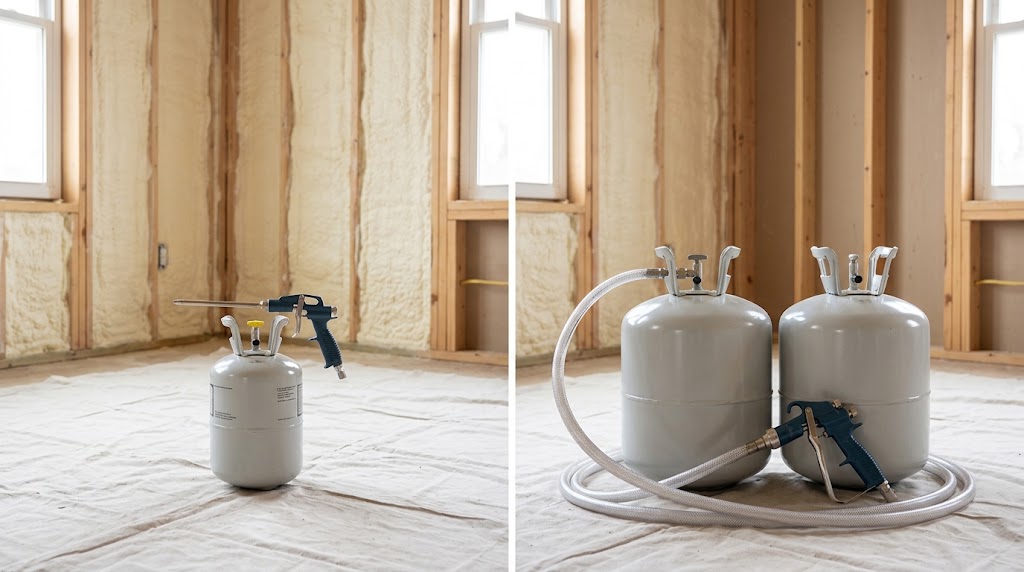
The simple difference is this: one-component foam comes ready to apply, while two-component foam combines two materials during application. One-component products are convenient for smaller jobs. Two-component systems are generally better when you need wider coverage, controlled thickness, and higher insulation performance.
One-Component vs. Two-Component Spray Foam at a Glance
|
Factor |
One-Component Spray Foam |
Two-Component Spray Foam |
|
Components |
One ready-to-use material |
Separate A-side and B-side |
|
How it cures |
Usually reacts with moisture |
Components react when mixed |
|
Setup |
Simple |
More preparation required |
|
Best project size |
Small to moderate |
Moderate to large |
|
Application control |
Good for targeted areas |
Better for continuous coverage |
|
Common format |
Canister or foam can |
Two cylinders with hose and gun |
|
Main advantage |
Convenience |
Coverage and performance |
The EPA describes one-component polyurethane foam as a moisture-cured product. Two-component systems combine separate chemical sides during application.
What Is One-Component Spray Foam?

One-component spray foam keeps the material in one container, so you do not need to mix an A-side and B-side before spraying. Many products continue curing through contact with moisture in the surrounding air.
That simple setup makes single-component foam options useful when you want controlled application without handling two separate tanks. VB Insulation lists these products for small-scale insulation and sealing work, with no mixing required.
Where Does One-Component Foam Work Best?
One-component foam can make sense for:
-
Small insulation areas
-
Gaps and hard-to-reach spots
-
Repairs and touch-ups
-
Targeted air-sealing work
-
Projects where simple setup matters
Not every one-component product is just a basic gap filler. Product formulas differ, so always check its listed coverage, R-value, approved uses, and application instructions before deciding where to use it.
What Is Two-Component Spray Foam?
Two-component foam uses two separate materials, commonly called the A-side and B-side. The A-side contains isocyanate, while the B-side contains a resin blend. They meet at the applicator and react to form polyurethane foam.
This system can create consistent foam across larger areas when properly applied. VB Insulation carries closed-cell spray foam kits in several board-foot sizes, allowing users to match the kit more closely to the project.
Why Does Having Two Components Matter?
The reaction starts when the A-side and B-side meet. The foam does not depend only on moisture moving inward from the surrounding air. This makes two-component systems better suited to building controlled layers across walls, basements, crawl spaces, and similar areas.
What Are the Main Differences?
|
Difference |
One-Component |
Two-Component |
|
Mixing |
No separate mixing |
A and B mix during spraying |
|
Cure process |
Commonly moisture-cured |
Chemical reaction between two sides |
|
Equipment |
Can and applicator |
Tanks, hoses, gun, nozzles |
|
Learning curve |
Lower |
Higher |
|
Large-area efficiency |
More limited |
Better suited to scale |
|
Thickness control |
Product-dependent |
Better suited to layered applications |
|
Material management |
Simple |
Mix ratio and temperature matter |
If you want more background on what goes into polyurethane foam, the closed-cell foam components help explain the chemistry without changing the basic buying decision.
Why Cure Depth Matters
Cure depth is easy to overlook. Moisture-cured one-component foam receives moisture from the surrounding environment. Applying certain products too thickly can slow or interfere with curing deeper inside the foam. The correct application thickness depends on the specific manufacturer's instructions.
Two-component foam creates its curing reaction as the materials combine. This supports more controlled passes or “lifts.” The Spray Polyurethane Foam Alliance defines a lift as foam built from connected passes, with multiple lifts sometimes used to reach the final thickness.
What Does “Off-Ratio Foam” Mean?
Two-component systems add an issue that one-component foam does not have: mix ratio. Both sides must feed correctly. If one component becomes deficient during spraying, the result can be “off-ratio foam,” which may affect yield, performance, and application safety.
This is why tank temperature, hose setup, nozzle condition, and even spray behavior matter with a two-part kit. Following the product instructions is more important than trying to judge the mixture by appearance alone.
One-Component Does Not Mean Open-Cell
This distinction causes a lot of confusion. Component count and cell structure describe different things. “One-component” or “two-component” describes how the product is supplied and reacts. “Open-cell” and “closed-cell” describe the physical structure of the cured foam.
For instance, VB Insulation's Purplecoat is marketed as a single-component closed-cell product. VB also sells two-component closed-cell systems, while two-component open-cell products are available as well. Therefore, you should not use “one-component” and “open-cell” as interchangeable terms.
How Do R-Value and Coverage Compare?

There is no single R-value that applies to every one-component or two-component foam. R-value depends on the actual formulation and installed thickness, so compare technical data for the exact product instead of choosing based only on the number of components.
For context, VB lists its Purplecoat single-component closed-cell foam at R-5.66 per inch with approximately 20 board feet of coverage per can. Its V600 two-component closed-cell kit lists R-7 per inch and 600 board feet of nominal coverage.
A board foot means a volume measuring 12 inches by 12 inches by 1 inch. Understanding this measurement makes comparing spray foam insulation choices much easier than comparing container size alone.
Which Foam Fits Different Projects?
|
Project |
Better Starting Point |
Why |
|
Small gaps or localized sealing |
One-component |
Easy setup and precise use |
|
Small repair area |
One-component |
Less equipment |
|
Larger exposed wall |
Two-component |
Better continuous coverage |
|
Basement or crawl space |
Two-component |
More practical for wider areas |
|
Large attic or roof area |
Two-component |
Higher output |
|
Existing enclosed cavity |
Specialized system |
Rise speed and application method matter |
These are starting points rather than universal rules. Surface type, required R-value, moisture conditions, building code, foam formulation, and total project size can change the right choice.
Fast-Rise vs. Slow-Rise Two-Component Foam
Choosing two-component foam does not finish the decision. You may also encounter fast-rise and slow-rise foam.
Fast-rise foam expands quickly and is commonly used on exposed surfaces. A fast-rise foam system can work well for open walls, foundations, basements, ceilings, and similar accessible areas.
Slow-rise foam expands more gradually and may be designed for injection or drill-and-fill applications in enclosed cavities. VB's closed-cell collection includes a slow-rise product specifically marketed for existing wall cavities.
This distinction matters because foam that expands too quickly inside a closed cavity can behave very differently from foam designed to rise gradually. Always match the rise profile to the intended application.
Is One-Component or Two-Component Better for DIY Projects?
For beginners, one-component foam generally involves fewer setup steps. You have one material source instead of two tanks, hoses, and a mixing nozzle. That makes smaller DIY projects easier to manage.
Two-component kits can also be used for DIY work when the product is designed for it, but preparation matters more. VB's DIY spray foam guide provides additional background for homeowners planning an insulation project.
For example, VB specifies a tank temperature range of 75°F to 85°F for its V600 kit and an application temperature of at least 65°F for best yield. Requirements vary, so the instructions for your exact kit always take priority.
What Safety Precautions Do Both Types Require?

“Easier to apply” does not mean chemical exposure should be ignored. Spray polyurethane foam products can expose users to vapors, aerosols, or uncured chemicals during application. EPA guidance recommends appropriate ventilation, eye protection, protective clothing, gloves, and product-specific respiratory protection where required.
Anyone considering whether they can install spray foam themselves should review the Safety Data Sheet and manufacturer instructions before spraying, especially in attics, crawl spaces, or other areas with limited ventilation.
One-Component or Two-Component: Which Should You Choose?
Choose based on project scale first, then compare the required insulation value, coverage, application location, cure method, and equipment.
For a smaller area where quick setup and precise application matter, one-component foam can be the practical option. For larger continuous insulation work, a two-component spray foam insulation kit usually offers more suitable coverage and thickness control.
Neither format is automatically better for every job. Matching the foam system to the application is what matters most.
FAQs
Is two-component spray foam stronger than one-component foam?
Two-component systems are generally designed for larger insulation applications and controlled foam thickness. However, strength, density, and R-value depend on the specific formulation. Compare product technical data instead of assuming every two-component product performs the same way.
Can one-component spray foam be closed-cell?
Yes. Component count and cell structure are separate properties. Some one-component products are closed-cell formulations. VB Insulation's Purplecoat is one example of a product marketed as single-component closed-cell spray foam insulation.
Is two-component foam always closed-cell?
No. Two-component systems can be available in both closed-cell and open-cell formulations. The two-component label describes how the chemicals are supplied and mixed, not whether the final foam has an open-cell or closed-cell structure.
What is a board foot of spray foam?
One board foot is a volume measuring 12 inches × 12 inches × 1 inch. A 600-board-foot kit therefore represents a theoretical material volume, not automatically 600 square feet at every installed thickness.
Which spray foam is better for a large insulation project?
Two-component foam is generally the better starting point for larger walls, basements, crawl spaces, attics, and other continuous insulation areas. One-component foam is often more convenient when the area is smaller and simple setup is a priority.