Open cell spray foam thickness is one of the most important design decisions in residential insulation. The correct depth is not determined by guesswork or by adding as much material as possible. It is determined by building science principles, climate requirements, and the function of the assembly.
Spray foam performs differently from traditional insulation because it provides both thermal resistance and air sealing. Once a continuous air barrier is established at the proper depth, performance gains begin to level off. Thickness must therefore be intentional and performance based.
Key Takeaways:
-
Open cell spray foam typically requires 3 to 3.5 inches in walls and 6 to 10 inches at roof decks.
-
Performance depends on achieving a continuous air barrier, not simply increasing thickness.
-
Climate zone, code requirements, and assembly design determine final insulation depth.
-
Uniform installation in controlled lifts prevents voids and ensures long term energy efficiency.
How Open Cell Spray Foam Works

Open cell spray foam is a low density polyurethane material that expands rapidly after application. This expansion allows it to seal cracks, joints, and framing gaps while filling cavities evenly.
Its primary functions include:
• Reducing uncontrolled air leakage
• Providing moderate R value per inch
• Improving temperature stability
• Supporting sound reduction within cavities
Because air sealing drives much of its efficiency benefit, correct installation depth matters more than excessive thickness.
Recommended Thickness by Application Area
Thickness requirements vary depending on location within the building envelope. Wall cavities are limited by framing depth, while roof decks often require deeper insulation to meet performance goals.
|
Application Location |
Typical Thickness Range |
Primary Objective |
|
Exterior walls |
3 to 3.5 inches |
Continuous air barrier and cavity fill |
|
Ceiling plane |
Around 5.5 inches |
Increased thermal resistance |
|
Roof deck attic |
6 to 10 inches |
Conditioned attic air control layer |
In standard 2x4 wall framing, 3 to 3.5 inches is generally sufficient to create a reliable air seal. Deeper application inside the same cavity is typically not possible without structural modification.
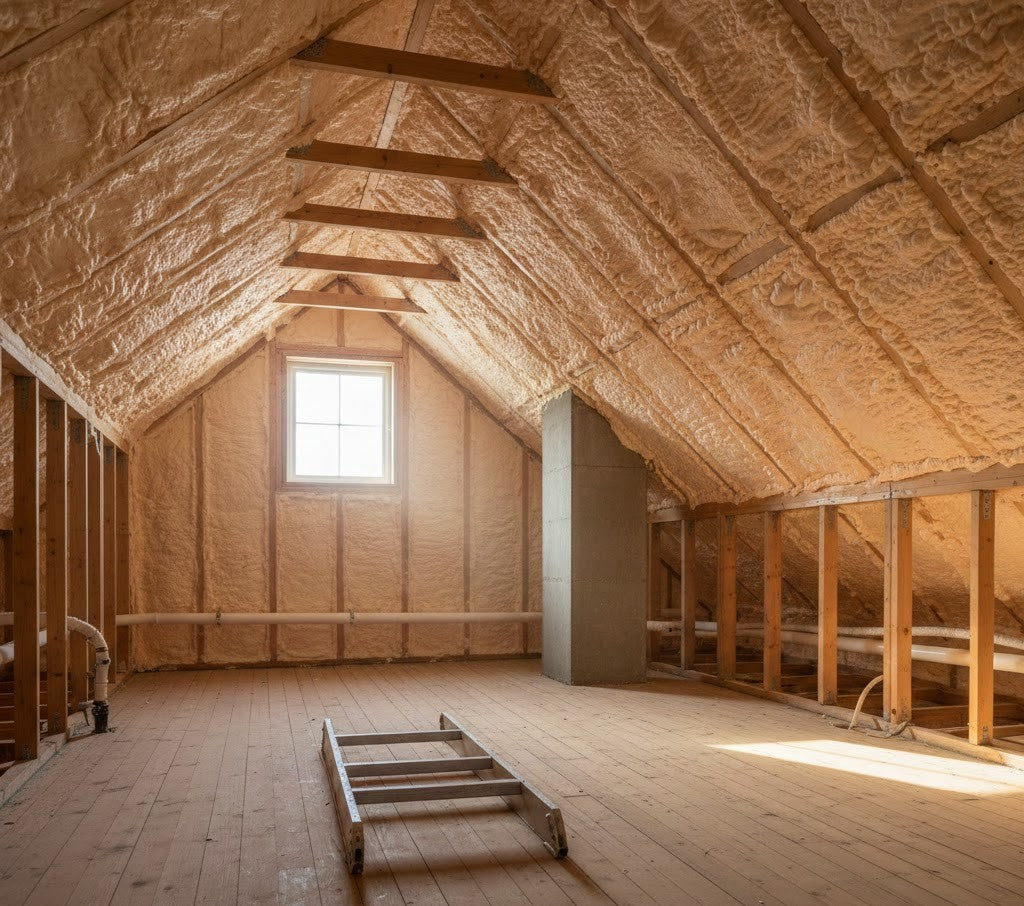
For attic roof decks, greater depth is often necessary because the insulation follows the roofline instead of resting on the attic floor. This converts the attic into a conditioned space. Thickness between 6 and 10 inches is common, depending on climate zone and energy targets.
Why More Thickness Has Diminishing Returns

After the recommended depth is reached and the air barrier is continuous, additional inches mainly increase R value incrementally. The most significant performance gain has already occurred through air sealing.
Excess application may lead to
• Higher material cost
• Longer install time
• Increased curing management
• Minimal additional comfort improvement
Energy efficiency improves most when air movement is controlled. A properly designed insulation system balances depth with overall building performance.
Climate Zone and Code Requirements
Building codes define minimum R value targets by climate zone. Colder regions require higher roof insulation levels than warmer climates. This may justify deeper foam or hybrid systems combining spray foam with other materials.
Important design considerations include
• Regional climate classification
• Roof type and slope
• Interior humidity levels
• Local energy code compliance
Open cell foam remains vapor permeable. In colder climates, moisture management strategies must be evaluated carefully.
When attic insulation strategies are compared in different assemblies, thickness decisions often depend on structural layout and environmental exposure, especially when evaluating roofline applications in attic foam selection guidance.
Open Cell Compared to Other Spray Foam Options
Selecting the correct spray foam type affects required thickness, moisture behavior, and long term performance. Open cell and closed cell foam serve different structural and thermal roles within a building assembly.
Open cell foam typically requires greater depth to achieve the same R value as denser alternatives. Closed cell foam delivers higher thermal resistance per inch and adds structural rigidity, but at a higher material cost.
The comparison below highlights the practical differences that influence thickness decisions.
|
Performance Factor |
Open Cell Spray Foam |
Closed Cell Spray Foam |
|
Density |
Low density, soft structure |
High density, rigid structure |
|
R Value Per Inch |
Moderate |
High |
|
Typical Wall Thickness |
3 to 3.5 inches |
2 to 3 inches |
|
Typical Roof Deck Thickness |
6 to 10 inches |
3 to 5 inches |
|
Vapor Permeability |
Vapor permeable |
Low vapor permeability |
|
Structural Reinforcement |
Minimal |
Adds structural strength |
|
Cost Per Inch |
Lower |
Higher |
Because open cell foam has a lower R value per inch, it depends on depth to meet performance targets. Closed cell foam can reach similar thermal resistance at reduced thickness, which can be beneficial when framing depth is limited.
Material selection should be based on climate zone, moisture control strategy, and assembly design rather than thickness alone.
In roof assemblies where space and vapor control are primary concerns, performance differences outlined in broader evaluations of spray foam insulation systems often influence the final specification.
For wall cavities that allow full depth application and prioritize air sealing and cost efficiency, open cell foam remains a practical and widely used solution.
Installation Depth and Application Quality

Correct thickness alone does not guarantee performance. Open cell spray foam must be installed with precision to deliver uniform air sealing and thermal control. Even when the specified depth is accurate, inconsistent application can reduce overall effectiveness.
Spray foam expands rapidly after contact. Installers apply it in controlled lifts rather than in one excessive pass. This approach allows proper expansion, curing, and adhesion to framing surfaces.
Key installation variables include
• Substrate temperature
• Ambient humidity
• Lift thickness per pass
• Spray technique consistency
• Full cavity coverage without voids
Improper conditions can affect foam structure and long term stability. For example, cold substrates may reduce adhesion, while excessive lift thickness may trap heat during curing.
The table below outlines installation factors that influence final performance.
|
Installation Factor |
Why It Matters |
Risk if Ignored |
|
Lift Thickness |
Ensures proper curing and expansion |
Shrinkage or structural weakness |
|
Surface Preparation |
Promotes adhesion |
Delamination from framing |
|
Temperature Control |
Maintains chemical reaction balance |
Incomplete expansion |
|
Even Coverage |
Maintains air barrier continuity |
Air leaks and cold spots |
|
Moisture Levels |
Protects material integrity |
Compromised foam structure |
Uniform depth across the entire cavity is critical. Small voids or missed areas reduce air sealing effectiveness even if average thickness appears sufficient.
Installers should verify cavity fill visually and measure depth at multiple points. Consistency matters more than isolated thick areas.
For residential applications where predictable expansion and reliable adhesion are required, professional grade open cell spray foam kits are formulated to support controlled installation practices across wall and attic assemblies.
When installation depth, environmental conditions, and material quality align, the specified thickness performs as designed and delivers long term energy efficiency.
Estimating Material Requirements
Spray foam coverage is measured in board feet. One board foot equals one square foot at one inch thick. Required material increases proportionally with thickness.
|
Area |
Thickness |
Board Feet Needed |
|
500 sq ft |
3 inches |
1500 board feet |
|
500 sq ft |
6 inches |
3000 board feet |
|
1000 sq ft |
3 inches |
3000 board feet |
Accurate measurement prevents under ordering or waste. Board foot calculations are based on surface area multiplied by intended depth, a method outlined clearly in this explanation of spray foam coverage formulas.
Energy Efficiency Impact
Open cell foam improves comfort by reducing air infiltration and stabilizing indoor temperatures. Heating and cooling systems operate more consistently when air leakage is minimized.
Performance improvements commonly include
• Reduced drafts
• More even indoor temperatures
• Lower HVAC workload
• Improved upper floor comfort
Air sealing plays a central role in overall performance, which is why system level benefits are often emphasized when discussing spray foam energy efficiency.
Selecting Reliable Open Cell Products
Thickness recommendations assume consistent material quality and proper expansion characteristics. Reliable formulations expand evenly, adhere well to framing surfaces, and maintain structural stability within cavities.
Residential projects that require dependable performance often rely on professionally engineered open cell spray foam kits designed for wall and attic assemblies. Larger scale projects or mixed applications may incorporate products from the broader range of spray foam insulation systems, where output capacity and coverage match project demands.
Final Considerations
For most residential walls, 3 to 3.5 inches of open cell spray foam provides an effective air barrier within standard framing. For attic roof decks, 6 to 10 inches is common depending on climate and code requirements.
The correct thickness is determined by performance goals, climate conditions, and assembly design. When depth is aligned with building science principles and installed with precision, open cell spray foam delivers reliable energy efficiency without unnecessary material use.
Frequently Asked Questions
Can open cell spray foam be too thick?
Yes. Excess thickness increases cost and curing time without proportionally improving performance once air sealing is achieved.
How do I know if my attic needs 6 inches or 10 inches?
Thickness depends on climate zone, local code R value requirements, and whether the attic is conditioned or vented.
Does open cell foam need a vapor barrier?
In many climates it does not, but cold regions may require additional vapor control depending on roof assembly design.
Will thicker open cell foam eliminate the need for ventilation?
No. Proper mechanical ventilation is still required to manage indoor air quality and humidity levels.
Can I mix open cell foam with fiberglass or cellulose?
Yes. Hybrid systems are common and used to meet higher R value targets cost effectively.
How long should I wait before reentering after installation?
Reentry time varies by product and ventilation conditions, but typically ranges from several hours to 24 hours.