Understanding whether you need a vapor barrier with spray foam insulation can prevent costly moisture problems. Many homeowners assume it’s always required, but the answer depends on the type of spray foam, climate, and building design. This guide explains when you need one, when you don’t, and how to make the right decision.
Quick Answer: Do You Need a Vapor Barrier?
In most cases, you do not need an additional vapor barrier with closed-cell spray foam, but you may need one with open-cell spray foam depending on your climate.
Key takeaways:
- Closed-cell spray foam → usually acts as a vapor barrier
- Open-cell spray foam → often needs additional vapor control
- Climate and building codes → determine final requirement
What Is a Vapor Barrier and Why It Matters?

A vapor barrier is a material that slows or blocks moisture from passing through walls, ceilings, or floors. Moisture can travel through air and materials, causing condensation inside structures.
Without proper moisture control:
- Mold and mildew can grow
- Wood framing can rot
- Insulation performance can drop
Modern building science focuses on controlling moisture movement, not just blocking it completely.
Does Spray Foam Insulation Act as a Vapor Barrier?
Closed-Cell Spray Foam
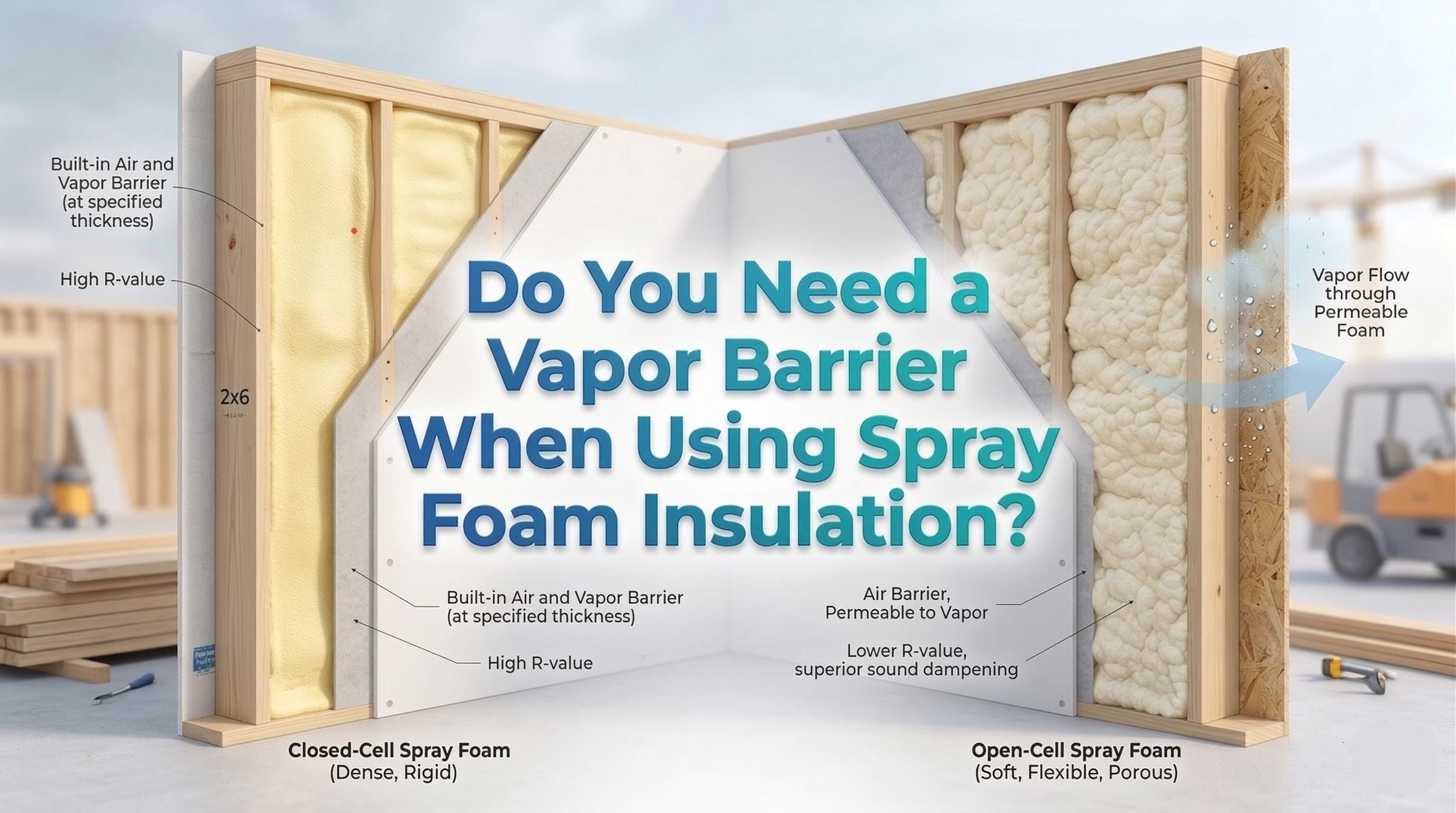
Closed-cell spray foam is dense and rigid. It creates both an air barrier and a vapor barrier when applied at the right thickness.
- Vapor impermeable at ~1.5–2 inches
- High R-value (~R-6 to R-7 per inch)
- Strong moisture resistance
This makes it ideal for areas prone to dampness, especially when considering how spray foam protects against moisture in areas like basements.
Open-Cell Spray Foam
Open-cell spray foam is lighter and more flexible. It allows moisture vapor to pass through.
- Vapor permeable
- Lower R-value (~R-3.5 to R-3.7 per inch)
- Better for soundproofing and interior use
Because it “breathes,” it may require additional vapor control in colder climates or high-moisture environments.
Open-Cell vs Closed-Cell: Vapor Barrier Comparison
|
Feature |
Open-Cell Spray Foam |
Closed-Cell Spray Foam |
|
Vapor Barrier |
No |
Yes (at proper thickness) |
|
Moisture Resistance |
Low |
High |
|
R-Value per Inch |
~3.5–3.7 |
~6–7 |
|
Best Use |
Interior walls |
Basements, exterior walls |
When You DO Need a Vapor Barrier

1. Cold Climate Zones
In colder regions, warm indoor air can condense inside walls. A vapor barrier helps prevent this buildup.
- Common in climate zones 5–8
- Typically installed on the interior side
2. Using Open-Cell Spray Foam
Open-cell foam does not block vapor. You may need:
- A vapor-retarder paint
- Plastic sheeting (in some cases)
This is especially important when working on basement projects where proper moisture control is critical, such as in spray foam basement use.
3. High-Moisture Areas
Areas with constant humidity often require additional protection.
Examples:
- Basements
- Crawl spaces
- Bathrooms
Moisture-heavy spaces benefit from systems designed to resist water intrusion, similar to approaches used in waterproof insulation benefits.
4. Local Building Code Requirements
Building codes may require vapor retarders depending on:
- Climate zone
- Insulation type
- Wall assembly
Always verify with local regulations before installation.
When You DON’T Need a Vapor Barrier
You typically don’t need an extra vapor barrier if:
- You are using closed-cell spray foam
- The foam is applied at sufficient thickness
- The structure allows proper drying
Adding unnecessary barriers can trap moisture and cause damage.
Climate-Based Recommendations
|
Climate Type |
Vapor Barrier Recommendation |
Notes |
|
Cold |
Often required |
Prevents condensation |
|
Mixed |
Case-by-case |
Depends on wall design |
|
Hot & Humid |
Usually not needed inside |
Allow drying outward |
Vapor Barrier vs Air Barrier (Common Confusion)
Many people confuse air barriers with vapor barriers. They serve different purposes.
- Air barrier → stops airflow (spray foam excels here)
- Vapor barrier → controls moisture diffusion
Spray foam insulation is always an air barrier. It is only a vapor barrier in certain forms.
Pros and Cons of Adding a Vapor Barrier
Pros
- Reduces moisture intrusion
- Prevents mold growth
- Helps meet code requirements
Cons
- Adds cost
- Can trap moisture if misused
- Not always necessary
Real-World Applications

Basements
Basements often need moisture control strategies. Proper insulation planning, like in basement insulation steps, helps avoid condensation issues.
Walls
Exterior walls in cold climates often require vapor retarders with open-cell foam.
Attics
Attic designs vary. Some require vapor control depending on ventilation and insulation type.
Decision Guide: Do You Need a Vapor Barrier?
|
Scenario |
Vapor Barrier Needed? |
Reason |
|
Closed-cell foam (2”+) |
No |
Already vapor resistant |
|
Open-cell foam (cold climate) |
Yes |
Prevent condensation |
|
Basement insulation |
Often yes |
High moisture exposure |
|
Hot climate walls |
Usually no |
Allows drying |
Expert Tips for Best Results
- Match insulation type to your climate
- Avoid double vapor barriers
- Focus on proper installation quality
- Consider long-term moisture behavior
Proper planning also impacts project cost efficiency, especially when evaluating basement insulation cost.
Get the Right Spray Foam Insulation Plan
If you are planning an insulation upgrade or want to avoid costly mistakes, it helps to get guidance tailored to your specific project.
The VB insulation team can help you determine whether a vapor barrier is necessary and recommend the right spray foam solution for your home’s structure and climate conditions.
FAQs
Do you always need a vapor barrier with spray foam insulation?
No, you don’t always need one. Closed-cell spray foam usually eliminates the need for a separate vapor barrier.
Key points:
- Depends on foam type
- Climate plays a major role
- Codes may override general rules
Can spray foam replace a vapor barrier?
Yes, closed-cell spray foam can replace a vapor barrier. It becomes vapor-resistant at sufficient thickness.
Important notes:
- Open-cell cannot replace it
- Thickness matters
- Installation quality is critical
What happens if you skip a vapor barrier?
Skipping it can lead to condensation and mold in certain conditions. This risk is higher in cold climates.
Possible issues:
- Moisture buildup
- Structural damage
- Reduced insulation efficiency
Is closed-cell spray foam always better?
No, it is not always better. It depends on your application, budget, and moisture conditions.
Comparison factors:
- Cost vs performance
- Moisture resistance
- Energy efficiency
Can vapor barriers cause mold?
Yes, improperly installed vapor barriers can trap moisture and cause mold growth.
To avoid problems:
- Ensure correct placement
- Avoid double barriers
- Allow drying paths