
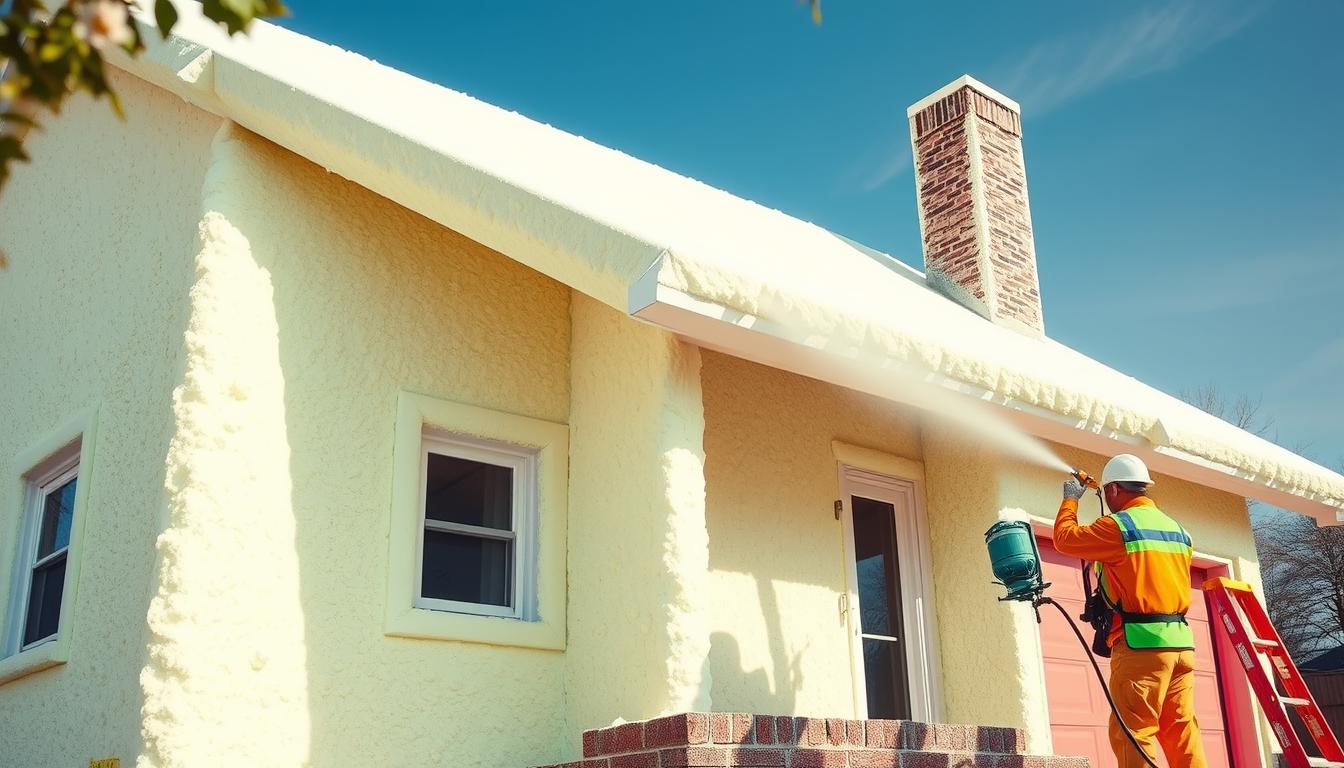
Are you starting an insulation project and asking, "How much spray foam do I need?" You're in the right place! This guide will help you figure out how much spray foam you'll need for your project. Whether it's for your attic, walls, or the whole house, we'll guide you through the steps to make your project a success.
Key Takeaways
-
Understand the different types and benefits of spray foam insulation
-
Learn how to measure the area to be insulated accurately
-
Discover the factors that influence spray foam coverage and R-values
-
Estimate the cost of your spray foam insulation project
-
Decide whether a DIY or professional installation is the best choice
Starting an insulation project can seem overwhelming, but with the right info, you'll feel ready. Let's get into how to find out exactly how much spray foam you'll need to improve your space.
Understanding Spray Foam Insulation
Spray foam insulation is now more popular because it works well and is versatile. It's made from a special mix of chemicals. This material has many benefits that make it a top choice for homeowners and contractors.
If you're planning a project and trying to estimate materials, understanding proper spray foam coverage helps ensure accuracy and efficiency from the start.
Types of Spray Foam Insulation
Closed-cell spray foam Closed-cell spray foam is top-notch for insulation, with an R-value up to R-7 per inch. It's a dense foam that seals air and moisture well, perfect for strong seals. Open-cell spray foam, on the other hand, has a lower R-value, around R-3.5 to R-4 per inch. It's lighter and more flexible, great for places needing a vapor-permeable barrier.
To better understand performance differences, knowing the closed cell R-value can help guide the right insulation choice.
Benefits of Spray Foam Insulation
-
Exceptional air sealing capabilities, reducing energy loss and drafts
-
Moisture resistance, preventing mold and mildew growth
-
Enhanced structural integrity, as the foam can strengthen building materials
-
Superior sound insulation, providing a quiet living or working environment
-
Long-lasting performance, with a typical lifespan of 80 years or more
Spray foam insulation has many benefits for energy efficiency and comfort. Knowing the differences between closed-cell and open-cell foam helps you pick the best for your project.

Determining the Area to Be Insulated
First, you need to measure the area you want to insulate. This means looking at walls, ceilings, and other surfaces for spray foam insulation. Getting the measurements right helps you order the right amount of spray foam. This makes your project go smoothly and efficiently.
Accurate planning becomes easier when you understand wall insulation sizing and how different surfaces contribute to total coverage.
Measuring Wall and Ceiling Dimensions
To figure out how much spray foam you need, follow these steps:
-
Measure the length and height of each wall you're insulating. Then, multiply these to find the square footage for each wall.
-
For the ceiling or attic, measure its length and width. Multiply these to get the total square footage.
-
Add up the square footage of all walls and the ceiling. This tells you the total area needing spray foam insulation.
Knowing the total square footage helps you estimate the proper spray foam coverage needed. This reduces waste and makes sure your insulation works well.
|
Room |
Length (ft) |
Width (ft) |
Total Area (sq ft) |
|
Living Room |
15 |
20 |
300 |
|
Bedroom |
12 |
14 |
168 |
|
Attic |
30 |
40 |
1,200 |
|
Total Area |
1,668 sq ft |
By measuring walls, ceilings, and other areas well, you can find the total square footage for spray foam insulation. This helps you order the right amount of spray foam. It ensures you get the spray foam coverage and insulation you need.
Calculating Spray Foam Coverage
Coverage depends on foam type and thickness:
-
Closed-cell: ~30–50 sq ft per gallon
-
Open-cell: ~50–100 sq ft per gallon
A standard drum can cover 1,500–2,750 sq ft depending on application thickness.
Proper coverage planning also helps ensure effective sealing in areas vulnerable to leaks, where leak sealing capability plays a key role.
Estimating Spray Foam Coverage Rates
-
For closed-cell spray foam, you get about 30-50 square feet per gallon, depending on how thick you apply it.
-
For open-cell spray foam, you can cover 50-100 square feet per gallon, also based on the thickness you want.
-
A 55-gallon drum of spray foam can cover between 1,500 and 2,750 square feet. This depends on the foam type and how thick you apply it.
To figure out the total square footage of your project, measure the length and width of the areas you're insulating. Then, multiply these numbers together. This tells you the total area you need to cover with spray foam.
By using the total square footage and coverage rates, you can work out the approximate amount of spray foam you'll need. This helps you plan your purchase and make sure you have enough materials ready before starting the job.

Spray Foam Insulation R-Values and Thickness
Spray foam insulation is a top choice for keeping your home warm or cool. The R-value, which measures how well it insulates, can change based on the foam type. Let's look at how closed-cell and open-cell foam insulation differ and how thickness affects their performance.
Closed-Cell vs. Open-Cell Foam R-Values
Closed-cell spray foam insulation usually has a higher insulation r-value than open-cell foam. This is because it's denser and has more insulating gas in its cells. Closed-cell spray foam insulation typically has an R-value of R-6 to R-7 per inch.
On the other hand, open-cell foam insulation has a lower insulation r-value, usually R-3.5 to R-4 per inch. Its open structure lets air move more, which lowers its insulating power.
Choosing between closed-cell foam and open-cell foam depends on your project's needs, cost, and performance goals.
Read More: closed cell vs open cell foam cost
Spray Foam Insulation Thickness
R-value measures insulation effectiveness:
-
Closed-cell: R-6 to R-7 per inch
-
Open-cell: R-3.5 to R-4 per inch
Thicker applications increase insulation performance. Closed-cell foam is often chosen for areas needing stronger resistance to both air and moisture, including scenarios involving water sealing performance.
Estimating Spray Foam Insulation Cost
The cost of spray foam insulation varies a lot. Knowing the typical costs helps you plan your budget well.
The insulation cost of spray foam is between $0.44 and $1.50 per square foot. This depends on the foam type and how thick you need it. Spray foam insulation cost is usually higher than other insulation, but it's worth it for its long-term benefits.
When figuring out the cost of your spray foam insulation, think about these things:
-
Type of Spray Foam: Closed-cell foam costs more but insulates better and seals tighter.
-
Thickness: How thick you need the foam changes the cost. It affects the project planning and how much foam you need.
-
Project Size: Bigger projects might cost less per square foot because of economies of scale.
-
Labor Costs: Hiring a pro installer adds to the cost.
For a precise estimate of your spray foam insulation cost, talk to a local spray foam contractor or get quotes from several providers. They can look at your specific needs and give you a detailed cost breakdown.
DIY vs. Professional Installation
Homeowners can choose between DIY installation or hiring professionals. Each option has its pros and cons.
DIY Spray Foam
-
Lower upfront cost
-
Requires time, effort, and technical skill
-
Limited warranty options
Professional Installation
-
Ensures proper application and safety
-
Includes warranty protection
-
More efficient and compliant with building codes
Comparing overall insulation pricing factors can help determine whether DIY or professional installation fits your budget and expectations.
How Much Spray Foam Do I Need?

Finding out how much spray foam you need is key to a good insulation job. The amount depends on the area size, how thick you want the insulation, and the foam type.
A spray foam calculator can help you figure out how much you'll need. Just enter the space's dimensions, pick the foam type, and get an estimate of the foam volume needed. This way, you will only buy a little or not enough, saving time and money.
Here are some tips to help estimate your foam needs:
-
Measure the area's length, width, and height, like walls, ceilings, or attics. This tells you the square footage or cubic footage to cover.
-
Think about how thick you want the foam to be. A 2-6 inch thickness is usually best for good insulation.
-
Look up the manufacturer's coverage rate for the spray foam product. This helps you figure out the total volume you'll need.
-
Add 10-15% to your total to account for waste or uneven application during installation.
By thinking about these things and using a reliable calculator, you can order the right amount of spray foam. This way, you'll waste less and get the most out of your insulation.
|
Room Dimensions |
Spray Foam Needed (Closed-Cell) |
Spray Foam Needed (Open-Cell) |
|
10 ft x 12 ft x 8 ft |
30 board feet |
45 board feet |
|
15 ft x 20 ft x 9 ft |
60 board feet |
90 board feet |
|
20 ft x 25 ft x 10 ft |
100 board feet |
150 board feet |
These are just rough estimates. Always talk to a pro or use a calculator for your specific project.
Preparing for Spray Foam Installation
Before starting your spray foam insulation project, make sure to prepare the area well and follow safety steps. This ensures a safe and successful spray foam application.
